
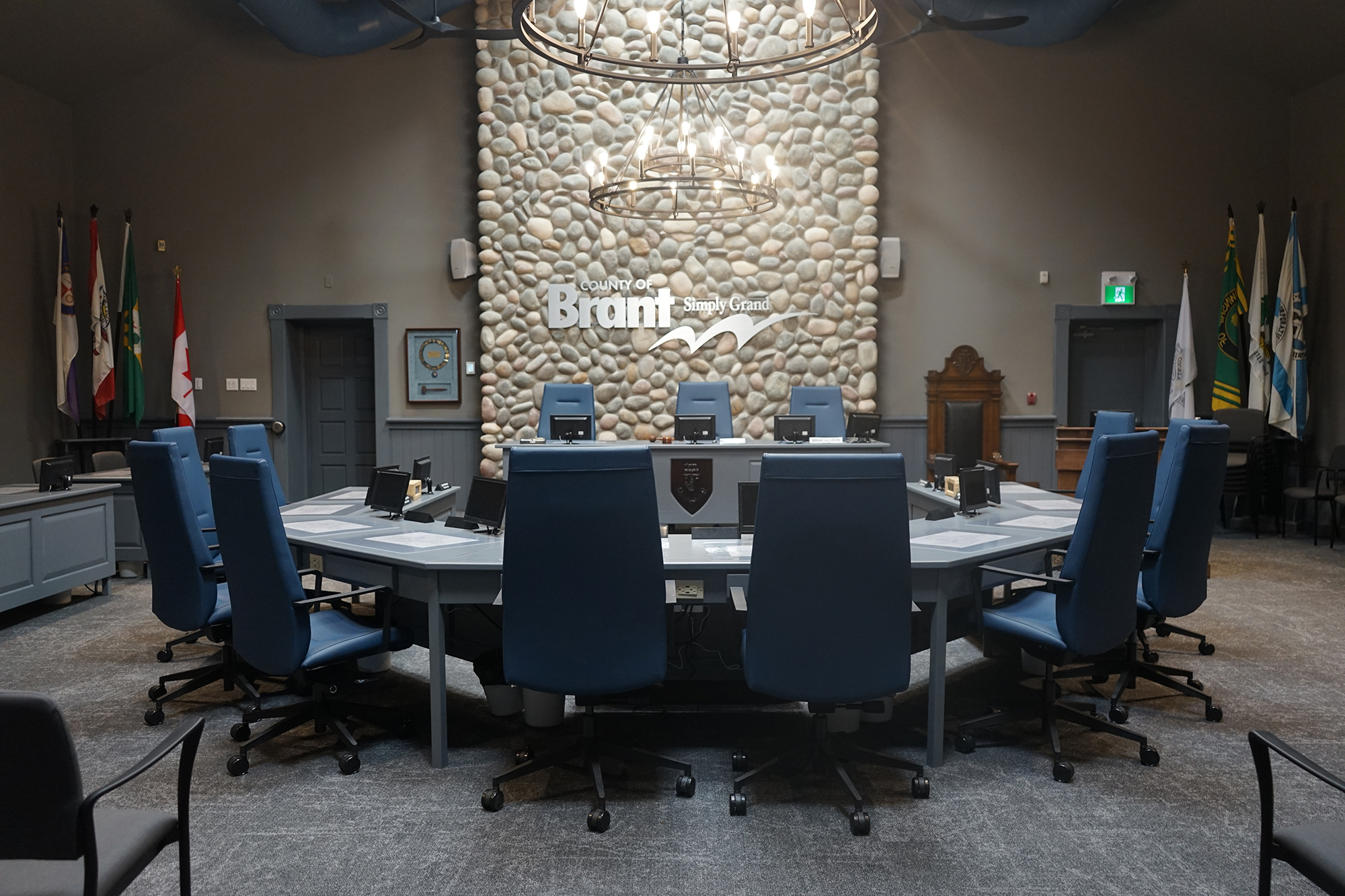
County of Brant Council learned more about several refinements for the proposed Community Planning Permit System during a special Council meeting on Tuesday, June 2, 2026.
First brought to Council back in October, the Community Planning Permit System (CPPS) is designed to help modernize the County’s entire zoning framework. The system combines several planning approval processes into one streamlined process.
In short, the CPPS will guide how land is used and developed within the County.
Currently, development applications like zoning changes, minor variances, and site plans are addressed through separate processes. The CPPS will consolidate them into one streamlined process.
“Once a CPPS is in place it cannot be appealed or amended for the first five years unless the Council agrees to do so through Council resolution,” said Chun Chu of Dillon Consulting. “It’s important to note that a CPPS does not replace the process for land division, and so a plan of subdivision and consent approval are still in place. Similarly, a CPPS does not replace a building permit approval, and so any construction or demolition of a building or structure would still need a building permit.”
According to the EngageBrant project page, this means that planning applications can be reviewed more efficiently, with fewer steps, while ensuring community needs remain top priority.
The page goes on to state that the CPPS will essentially help the County:
- Support the goals laid out in the municipality’s Official Plan.
- Secure spaces for community facilities, parks, open spaces and affordable housing options as a condition of the CPP application (meaning in order for a developer to get approval for something like reduced parking, they may be required to provide affordable housing to do so).
- Protect the environment, cultural heritage and archaeological sites.
- Provide great flexibility in development standards and
- Encourage well-designed future development.
With the CPPS, the number and complexity of applications that need to be submitted to build or renovate within the County would be reduced, as would the timeline for development projects.
For example, rather than submitting multiple applications at separate times, and seeking approvals through different decision-makers, a developer would be required to submit zoning and site design applications to be submitted as one. Public consultation would have to occur before the application is submitted, and only one decision would have to be made.
On the resident side of things, another example would be someone looking to build an Additional Residential Unit (ARU) on their property. Currently a small setback change could potentially require a minor variance application, a Committee of Adjustment meeting (with Council) and an appeal period before construction could happen.
The proposed CPPS would allow for minor adjustments that meet the established criteria, could be reviewed and approved directly by staff within 45 days.
“What we’re doing here is essentially introducing new zoning County-wide. There’s many different things that this new bylaw is going to address,” said Brandon Kortleve, Manager of Policy Planning. “We’re looking at getting rid of our Committee of Adjustment, so that certain decisions can be delegated to staff to move some of that simple decision making forward pretty quickly.”
During the meeting, Kortleve walked Council through a number of individual topics including permit classes and decision making authority, application examples under the new system, and facility, services and matters (extra height and density in the County), as well as feedback and refinements being made to the CPPS draft.
As far as decision making authority goes, Kortleve’s report explains that decision making would be broken into different classes.
“Staff-level decisions are proposed for clearly defined, measurable variations that are routine and limited in scope. These decisions are outlined as Class 1 and Class 2 permits, which include as-of-right permissions (Class 1) and some changes to setbacks, height, lot coverage, parking locations, site design and arrangement requirements similar to site plan control (Class 2),” he said. “More significant changes would still go to Council or require a formal amendment. This distinction is especially important for matters such as residential parking ratios. Limited flexibility is proposed at the staff level within clear limits. Broader changes would require an amendment to the CPPS By-law. Unless Council directs otherwise by resolution, no amendments may be made during the first five years after adoption.”
The report continues on, saying, “Class 3 permits are proposed to be decided by Council. These involve larger departures from the By-law or more sensitive planning matters that may have broader implications or set precedent. They are different than an amendment to the by-law in that they do not represent a diversion from the overall objectives but simply warrant a broader discussion before a decision is made. Amendments to the CPPS By-law would also remain with Council, as they involve policy-level changes to the permissions or structure of the By-law. “
The policy planning manager added that under the proposed CPPS, permanent zoning would be introduced for mobile home communities.
Given that current zoning bylaw does not permit people to live in a mobile home community year round, the new system would.
“There will be an opportunity for all of these parks to officially have that year-round zoning through this community planning permit system. It would be applied through this project, and then we would work with the parks individually to come to the agreements that are needed for what’s called a Municipal Responsibility Agreement for servicing. S that’s septic if there’s water requirements, making sure that mail delivery is covered, and ensuring roads are plowed in winter. …So this bylaw allows the 12-month year-round living, and we would work with the park owners on the specifics of what needs to be, what boxes need to be checked to make sure that that’s appropriate.”
In response to this, Councillors Steve Howes and David Miller thanked Kortleve, stating it was good news for the mobile home communities.
Mayor David Bailey also said he was happy to hear about the change.
“I’m really glad. We’ve been working on this for a long time and it’s the right thing to do. I’m so happy we’re doing it, and it really is a big deal. I think these homes are going to pop up everywhere and they should,” he said. “They’re affordable, they’re attainable, and they become communities. They’re not just places where you live.”
One resident asked what would be happening as far as property taxes within the mobile home communities, and Kortleve said that while he would assume the property tax situation would remain the same, staff will look into and confirm at a later date.
Throughout the lengthy presentation, councillors asked a variety of questions as far as process and implementation. They also expressed concerns around the potential of giving developers too much flexibility and freedom to push things through without Council’s involvement such as few parking spots, building height and the like.
Bell said while the system may be designed to make things easier, he was finding the process complicated.
“It is incredibly complicated. We have had to ask some very fundamental questions. I am not sure we all understand it fully either, and if we struggle with it, then goodness knows how the community at large will handle this. And I still have the sense that the bigger developers will just go their own way on this one,” he said. “I have not seen a single developer in this engagement process. I’ve not heard anything from staff to say the major developers think this is good, or they’d like to see change. So, who are we doing this for? If at the end of the day it’s to move some work from what comes to Council back to staff, there must have been a simpler way of doing that than what we’ve done here. I applaud Brandon and his team for doing this work, but I’m still not convinced.”
Kortleve later said that the CPPS will not just simplify or expedite the planning process, but will give the County ownership over the process.
“We, as the County of Brant, deserve a tool that was built in the County of Brant to serve planning for its residents, and that is what we are trying to do here. That is why staff initially came with this proposed tool, is because we saw that there was an opportunity to build it from the ground up. It’s not like the zoning and site plan framework that’s given to us in the planning act. We have more flexibility, we can build into it. Of course, it’s a learning process,” he said. “Of course, there’s fears about being one of the first municipalities to take this on. There’s others that have done it, but there’s also the opportunity to take that planning realm back into our own hands here in the County. And we, as staff, have stood behind that recommendation and still stand behind that recommendation, that is the main reason we’re taking this approach and proposing this.”
In the end, Councillors unanimously voted to direct staff to refine the CPPS and associated Official Plan Amendment based on Kortleve’s report, and to have staff bring a final version of both for potential adoption in July.
As far as next steps,the final CPPS draft will be released the week of June 15, and if passed, will come into effect as of August 1.
Kimberly De Jong’s reporting is funded by the Canadian government through its Local Journalism Initiative.The funding allows her to report rural and agricultural stories from Blandford-Blenheim and Brant County. Reach her at kimberly.dejong@brantbeacon.ca.


