
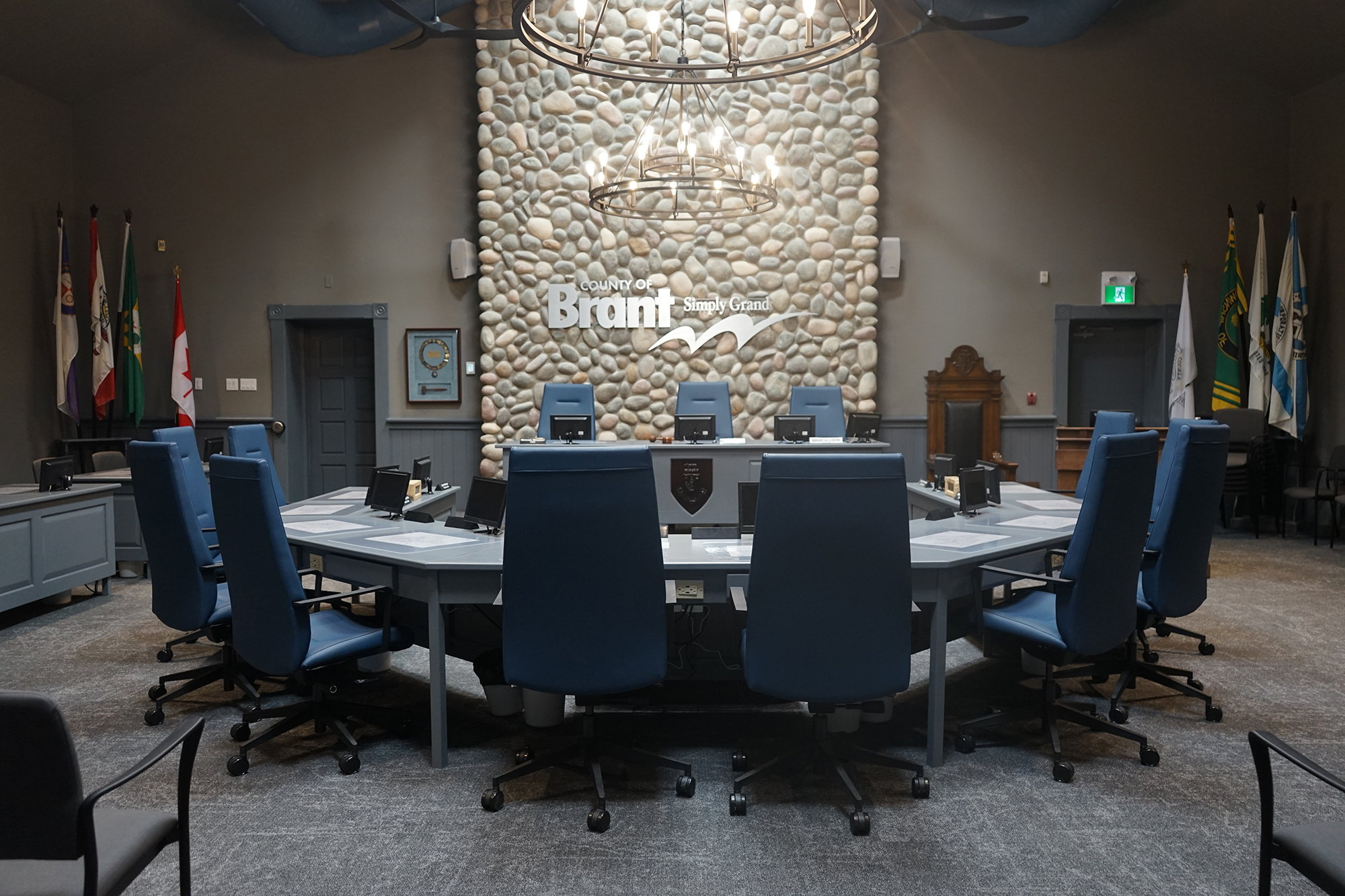
County of Brant Council discussed making adjustments to its agricultural policy during the regular Council meeting on Tuesday, May 12, 2026.
The adjustments are part of a larger Official Plan Amendment project to update sections of the Official Plan to ensure various policies are current, effective and aligned with Provincial policy, emerging issues and local implementation.
Brandon Kortleve, Manager of Policy Planning, said one of the key objectives of the agricultural policy adjustment is to provide long-term protection of agriculture in the County.
“The impetus behind this was a focus on smaller individual land-use decisions, and how they can collectively impact the future of farming in Brant,” he said.
The manager of policy planning went on to say that the amendment introduces a more structured and focused approach, but that it’s a systems-based approach that the Province requires the municipality to consider in agricultural planning.
“We’re putting in clear limitations on lot creation, non-farm uses and development pressures that contribute to land fragmentation over time,” said Kortleve. The goal is to ensure that the individual decisions that are being made, no matter how minor they may seem, are considered and consistent in terms of accumulative impact on the agricultural system. Think of it like a blanket; a tear or a burn in a blanket in one spot may not seem significant, but if it’s repeated over time, you lose and compromise what the blanket is intended to do. These changes that we’re proposing are intended to close the door on the opportunity to burn holes in the blanket.”
He said that over the past year, staff have reviewed best practices from other municipalities, and have engaged with the agricultural community through the Agricultural Advisory Committee and through the Brant County Federation of Agriculture.
According to the report, some of the challenges around implementing the County’s agricultural policy over the last 26 years has to do with ambiguity in policy interpretation, and the cumulative impacts of incremental fragmentation that has resulted from consent applications.
“Over 60 per cent of the properties within the County’s prime agricultural area are ten hectares in area or less (2,370 properties out of approximately 3,870). Although rural residential severances are no longer supported (as of 2023), surplus dwelling severances are not consistently achieving the intended outcome of long-term farmland consolidation that would help address fragmentation,” stated the report. “In practice, they have resulted in the permanent separation of dwellings from farm operations without a corresponding benefit to the greater agricultural land base. This approach has created over 4000 hectares of farm parcels where no dwelling can be constructed (indicated with a site-specific A-9 zoning code).”
Kortleve went on to explain that surplus farm-dwelling severances are common throughout the County of Brant and Ontario, and are enabled by the Provincial Planning Statement (PPS). However, one of the requirements for doing so is consolidation.
“Currently, we require a farmer who’s undertaking surplus farm-dwelling severance to consolidate with their farm operation in Brant, or a neighbouring municipality. They do not have to have parcels that are side by side, as long as they own more than one parcel in a farming operation, they may qualify,” he said. “What we are proposing is to make that a bit stricter and consolidate the parcels, and require the consolidation with the neighbouring piece of land. One of the zoning codes that’s common in the municipality is A-9, and that is a requirement of the consolidation under the current framework to prohibit a house or dwelling on the remnant farm parcel. That is also a requirement of the PPS, which in a sense sterilizes the ability to build a house for someone else down the road but leaves land that does not have homes, it’s just simply for farmland.”
Councillor Robert Chambers later said that agricultural policy is based on the foundation of preserving and protecting agricultural land.
“You preserve agricultural land by not allowing people to build on it, and you protect it by not allowing people to build things that have a negative impact on the agricultural system – that’s planning 101,” he said. “It’s also planning 101 that planning authorities regulate planning uses, not ownership. In other words, anybody can buy an agricultural property, but they can’t use it for anything other than agriculture. A developer can buy a 100-acre farm, but they can’t build houses on it, they have to use it for agriculture.”
He went on to say that the A-9 zoning has “time and time again” assisted farm families to continue their operations.
“These A-9 fields are actually in high demand for farms, both livestock and cash crop, and other farming operations, because they need those fields to consolidate with their existing farm operations to have the land mass to remain viable,” said Chambers. “It does not affect small farms, because they can be small farms, but if you have a large farm and need additional land to cash flow your operation, you need to be out looking for farm properties, and these ‘orphans,’ as you call them, are in high demand. Why? Because they’re used in farming operations.”
The councillor said he was very much opposed to changing the A-9 zoning code.
Chambers later tried to move “that the policy with regard to surplus farm-dwelling severances remain unchanged from the existing Official Plan.”
The amendment was later defeated, noting that Mayor David Bailey and Councillors Brian Coleman, David Miller and Chambers were the only ones to vote in favour.
Chambers, upon seeing the result of the vote, was visibly upset and promptly got up from his seat, walking away from the table only to return a minute later.
Noting that there was some confusion around the horseshoe about the pros and cons of what was being proposed in regards to the A-9 zoning, Councillor John Bell then requested that the report in its entirety be tabled.
“I would like to make a motion to table this issue until we get some clarity about the relative benefits of dropping A-9 or changing A-9 as is suggested, or not changing it,” he said. “I think we are in no position to actually understand how to make that decision at the moment.”
The vote to table the report was carried unanimously.
Kimberly De Jong’s reporting is funded by the Canadian government through its Local Journalism Initiative.The funding allows her to report rural and agricultural stories from Blandford-Blenheim and Brant County. Reach her at kimberly.dejong@brantbeacon.ca.


