
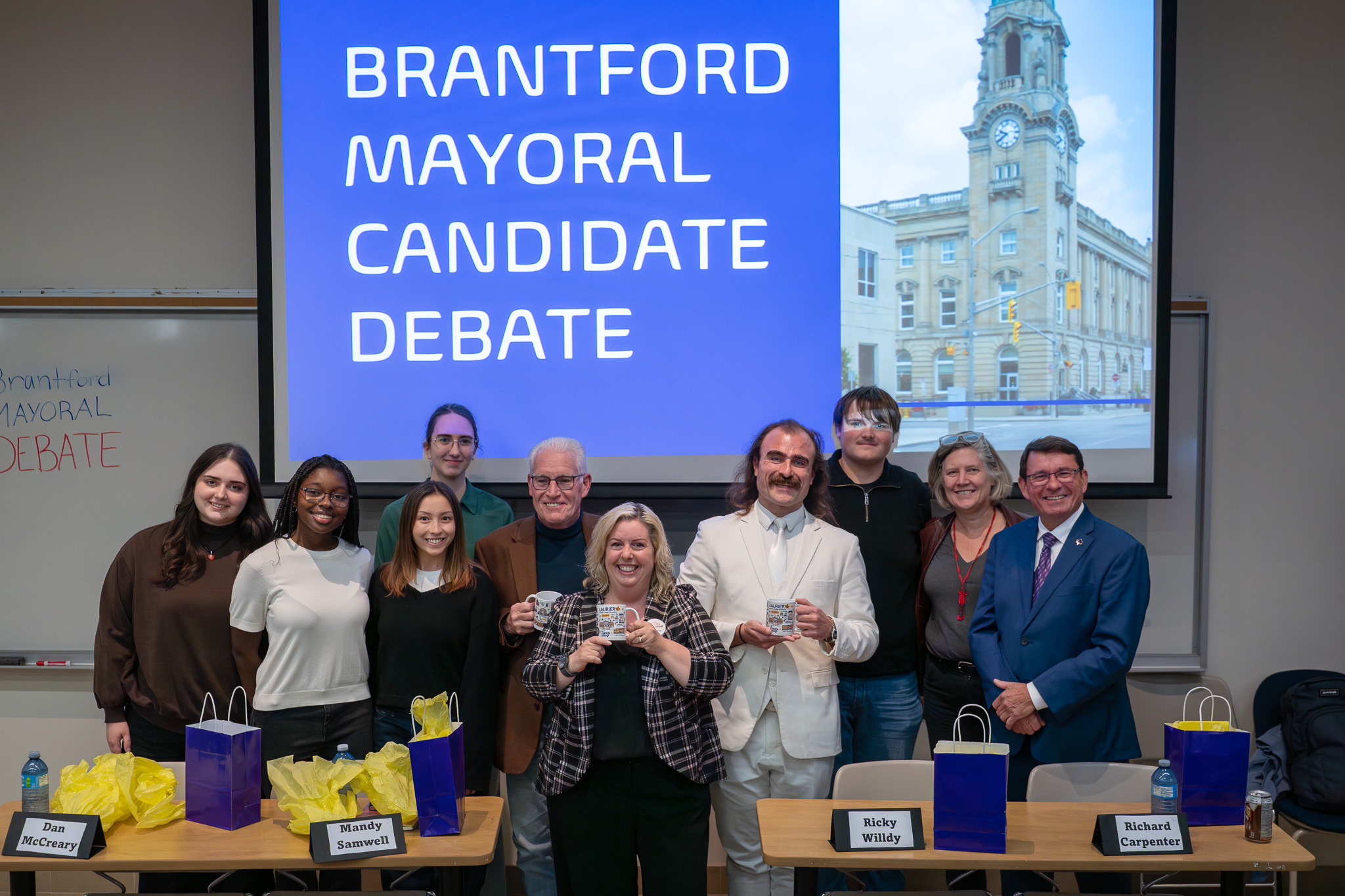
Wilfrid Laurier University’s Brantford campus’ Law and Society Student Association hosted a Brantford mayoral candidates’ debate on Monday, October 19, 2026.
With online and advance voting already underway, the debate gave Laurier students and the community the opportunity to hear directly from mayoral candidates ahead of Election Day on Monday, October 26, when residents will elect their next mayor, ward councillors and school board trustees.
While all seven mayoral candidates were invited to participate in the debate, only four were present: Dan McCreary, Richard Carpenter, Mandy Samwell and Ricky Willdy.
Law and Society Student Association (LSSA) Vice-President Tatiana Reid said the idea for the event came from the students’ Canadian Legal System class, with the goal of encouraging civic engagement.
“When our professor, Kelly [Gallagher-Mackay], said it would be a great opportunity to put something on like this, we just ran with it,” she said. “And considering the voter turnout for our generation in particular is not there, we figured anything we could do to encourage that would be a good idea.”
Sydney Cooper, LSSA events director and debate moderator, noted that with many students, including herself, preparing to vote in an election for the first time, the debate offered a valuable opportunity to hear directly from candidates about issues affecting their community.
“This is my first time I’m going to be voting in an election ever, and I know that’s the same for a lot of people, especially students who are going to be in this room. So to have a personal chance to really engage with the candidates who are in our own community, it means a lot to everyone here,” she said. “Brantford is our home, our community, and we shouldn’t be afraid to really engage with it. This election is going to determine the future of the community we all share, so it’s really important that we participate and make sure that it has the brightest possible future.”
Sabrina Miller, president of the Laurier’s Indigenous Student Association and co-organizer of the event, added that the debate also helped connect Indigenous students with local candidates, highlighting the impact of Brantford’s municipal decisions on the Six Nations community.
“The Indigenous Student Association was excited for the opportunity to get involved because Indigenous students typically don’t get one-on-one with these candidates because they’re in a different area, but things that happen in Brantford affect the Six Nations community,” she said. “We have students here that are part of the urban Indigenous population, as well as on reserve, so it’s really helpful for them to come and meet local candidates, and then take the information back and talk to their family and friends about what was discussed.”
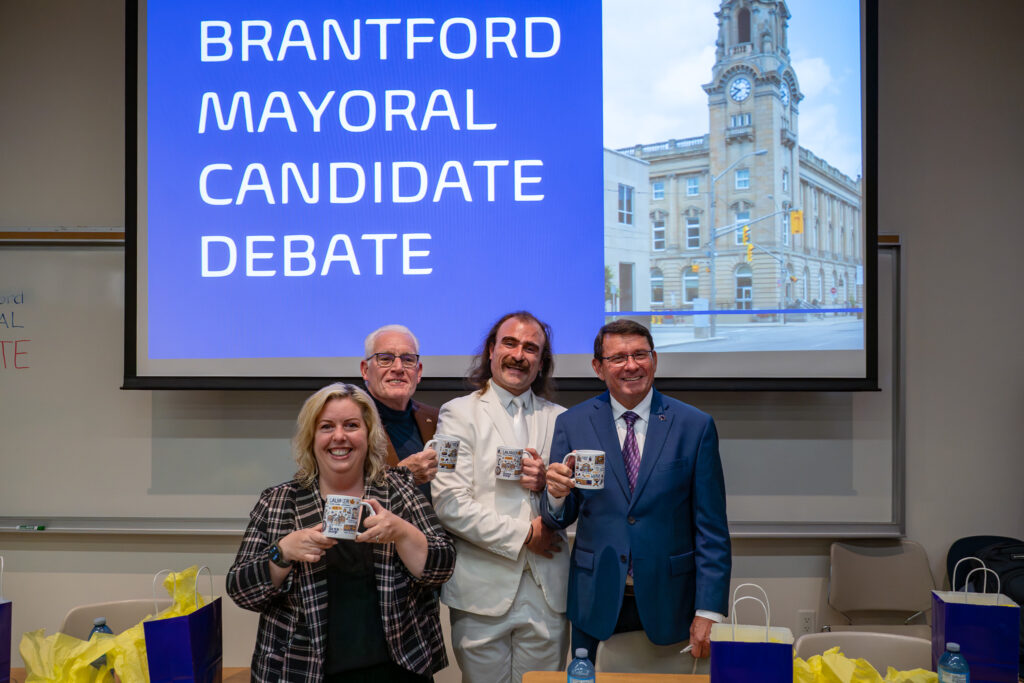
As the debate got underway, the candidates were given four questions covering several key municipal issues, including balancing city priorities with community input and data, traffic congestion and public transportation, Indigenous representation in municipal decision-making, and homelessness, affordable housing and student safety.
Reid said the questions were formed by reviewing each candidate’s platform and connecting with their fellow students about their concerns for the community.
Candidates were each given one minute and 30 seconds to answer, followed by one minute for a rebuttal. Each candidate was then asked a question based on their specific platform, with two minutes and 30 seconds to respond.
McCreary’s question revolved around balancing affordable property taxes with the need to invest in services infrastructure. Samwell was asked about new housing development and the City’s road infrastructure. Willdy was asked about balancing the need for more housing while protecting green spaces, and Carpenters revolved around prioritizing healthcare access.
The debate concluded with a question-and-answer period, allowing students and those present to ask their own question.
Some asked about the removal of curbside recycling for institutions like Laurier and businesses, while others asked how student life and the university experience could be improved, as well as the significant divide between the Six Nations Elected Band Council, the Haudenosaunee Development Institute and the Hereditary Chiefs.
Candidates were then given the opportunity to make their closing statements, encouraging the students and those present to get out and vote.
When asked what advice she had for students eligible to vote in this year’s election, LSSA President Lilly Overney encouraged them to take every chance to learn about the candidates and their plans for the city.
“Try your best to educate yourself. Come out to community events like this. Be aware of what’s going on in your community and ask questions,” she said. “That’s why I was so excited about today, because it’s a great opportunity for students to just come and listen to what’s going on in the community. I think that is really important, especially because students have a really big voice that we need to use.”
Kimberly De Jong’s reporting is funded by the Canadian government through its Local Journalism Initiative.The funding allows her to report rural and agricultural stories from Blandford-Blenheim and Brant County. Reach her at kimberly.dejong@brantbeacon.ca.


