
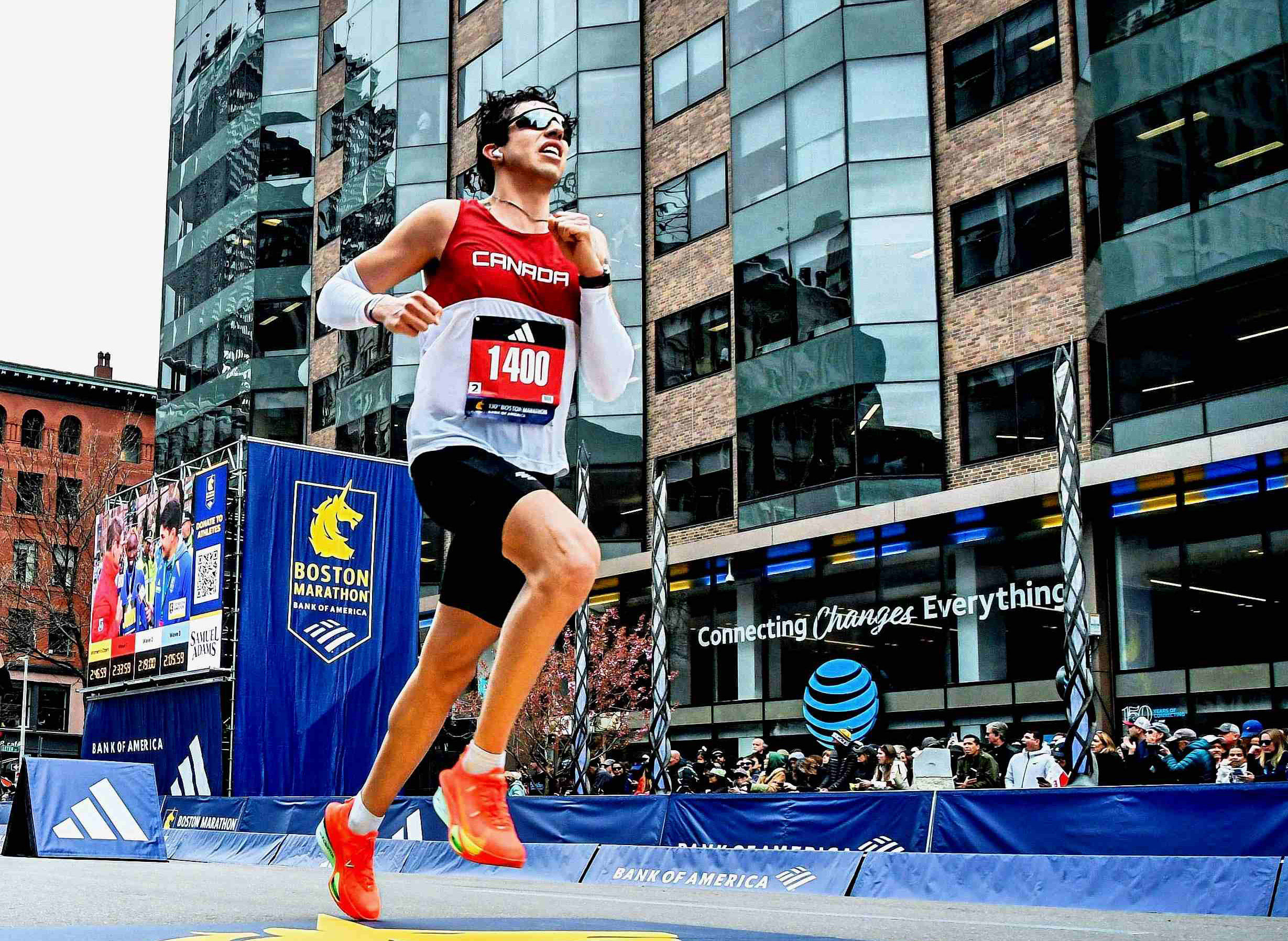
For Kristian Jamieson, long-distance running has become an important part of his life and one that has forged a stronger connection with his great-great-grandfather, Tom Longboat, who was one of the best runners of the early 20th century.
Jamieson, who grew up on the Six Nations, discussed his start in running as a young adult.
“In my childhood, I really didn’t run that much…I had to do some track and field in elementary school, but I never ran track or did cross country in high school, and during my time in undergrad, I never ran for any club or organization. But I played hockey for most of my childhood, from the age of eight to when I was about 18. I was just obsessed with hockey,” he recalled. “I started to run very late in my adolescent years…. Around COVID in 2020. It was just kind of something I did solo. As an athlete, I didn’t want to be stuck indoors, so I started to run.”
Early on, Jamieson drew inspiration from an ultra-marathon runner, helping push himself to his limits.
“His name is David Goggins. He was a Navy SEAL…running triathlons. He wrote a book called ‘Can’t Hurt Me,’ and I would listen to his audiobook on repeat when I would go out on my runs. He really inspired me to the limits of my mind and my mental strength, and kept me wanting to do longer and longer distances. It’s typical for many runners, especially marathon runners, to work their way up. They start by doing a 5k, 8k, or 10k, or a half-marathon. But in Goggins book, he talks about pushing the limits and that really intrigued me to do longer distance running, especially when I was just starting,” Jamieson noted. “I’ll never forget this one time I was setting out to do a 10K run, and ended up running 30 kilometers. At the time, I was new to running, so I didn’t have a proper pair of running shoes. It was a hot summer day; I had no water….and I was just able to use grit and determination to get the run done. At the end, I was very tired and overwhelmed, but it was an eye-opener. I was able to do this with no real preparation…I just went out there and did it. And I thought that there was more to this…So, I kept pushing the limits and saw how far I could go as a runner. As I became more invested, running became a lifestyle…and fast forward to today….running has consumed my life, and has become a big part of who I am.”
However, along with pushing himself, Jamieson also looked at self-improvement and being the best version of himself, fueled by running.
“In the beginning of my running journey, it was about self-improvement. One of the themes of Goggin’s book is his tough childhood. His upbringing was not very good…but he was able to deal with the cards he was given. He figured out a way to flip his life around for the better and make the most from what he was dealt. His story resonated with me because I spent an early part of my childhood on the Six Nations Reserve [and] some memories are growing up that I wasn’t so fond of. During that time on reserve, I wasn’t living with my parents [and] there were a lot of times I’d be late going to school, and at other times I wouldn’t even show up. And no one seemed to really care what I was doing. So, reading that book really got me motivated and running as a way of self-development and self-improvement and becoming more confident,” he said. “I also started to eat better and followed a consistent sleep schedule…having time for my body to recover after my runs. My life changed for the better…finding this passion for running buried within me. And when I found out about Tom Longboat…it really added fuel to the fire.”
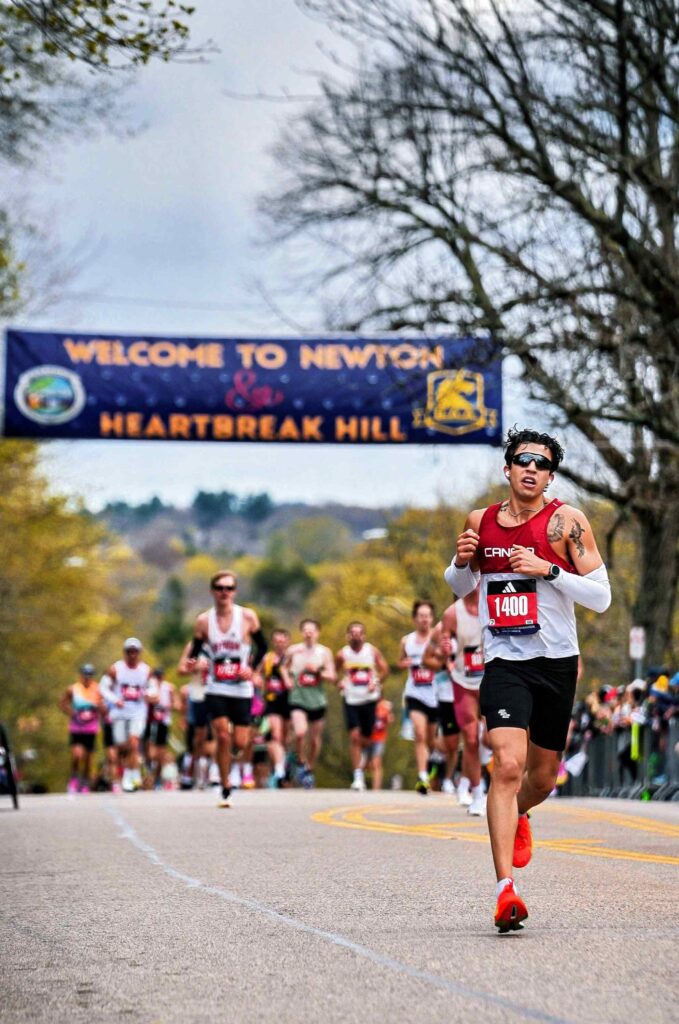
As he has continued to grow as a runner, Jamieson would delve deeper into learning more about Tom Longboat.
“I’m sure his story was relayed down to me many times. But as a youngster, those stories went in through one ear and out the other. I didn’t think much of it, because I wasn’t a runner. But when I really started getting into running, I became interested in Tom Longboat and his legacy. I started to do my own research….using Google, and I would ask my family about him. As kids, we have role models, people that we look up to, like athletes. And for me….my role model was someone in my bloodline…in my family lineage who was a marathon world champion in 1909 when he won the world championship in New York City…and who won the Boston Marathon in 1907. It was so motivating for me to learn more about him…who was an incredible athlete and one of the world’s greatest runners in that era…and I’m part of that lineage,” he noted.
During his research, the upcoming runner would find an athlete who was misunderstood and ahead of his time.
“One of the things was that he would often get criticized for his training style. Back then, it was often believed that you should be running hard every single day…one had to stress the body to make it fit. But instead, he would take days off, or he’d go on long walks, or he’d run easy, or just completely rest his body. He would get backlash from coaches, the media, and the general public for the way he approached running….but he had a strong will…. standing up to that criticism. And remaining true to himself and doing what was best for himself. When I found that out, I took that piece of advice….that, at the end of the day, no one knows your body better than you yourself,” he said. “Being able to stay true to yourself, is something that takes experience as a runner…and to know your limits as a runner, and to know when you can step on the gas or you have to put the brakes, especially during a race, you have to be in tune with your body….[and] that’s something that can’t be taught. It’s also knowing when to go hard, and when not to. And just sticking up for myself, standing for what I believe in and not letting that outside noise or distractions get to me. I try to take that with me, throughout every part of my life, not only in running, but in school and everyday life circumstances.”
Nevertheless, one of the goals for Jamieson along with running, is to use Longboat’s story to inspire others including those in the First Nations community.
“One of my missions is to uplift the First Nations community through Tom Longboat’s journey. He was the first indigenous Canadian to win a Boston Marathon…he also competed in the 1908 Olympics, [and] served in World War I. If I can relate those accomplishments and that bit of Canadian history to people today and inspire them. Because ultimately, it inspired me, if it weren’t for this story, I don’t think I would have continued as a runner. I definitely wouldn’t have the motivation and the hunger that I have become. So, I know that, if it inspired me to this extent, there’s some other young kid out there who hears that story and decides to chase their dreams as well,” Jamieson noted.
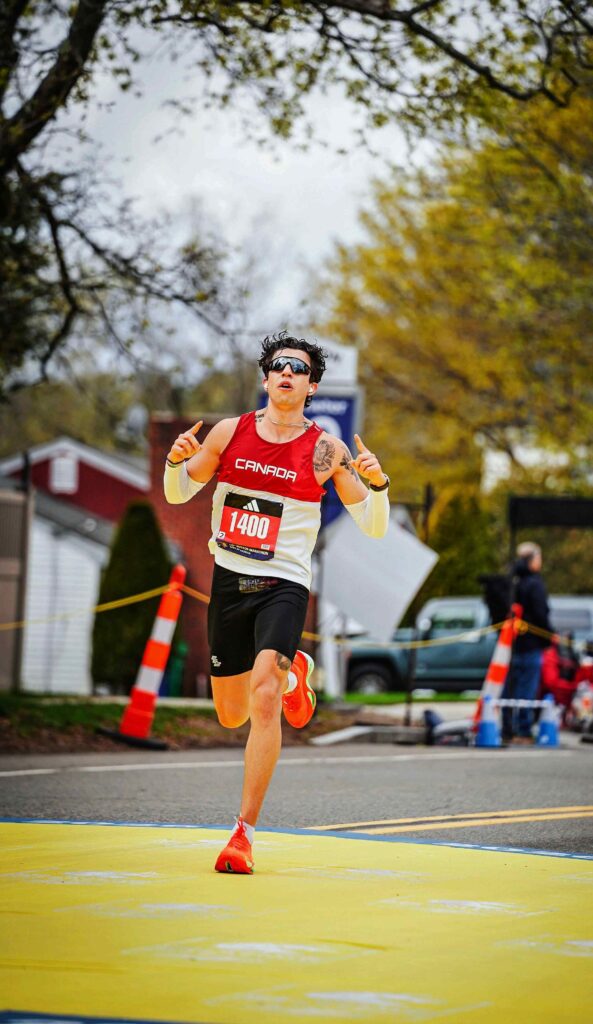
However, as the runner progressed over the years, he has also found two mentors, his coach Derek Silva, a sociology professor at Western University, and Rick Mannen, a long-distance runner from Brantford.
“I respect these two individuals tremendously. Rick has a background as runner…competing in marathon world championships. He has accomplished so much and got to a place that I’m trying to get to…and seeing the times that he ran, that’s something that I look to do….which is why I value the connection that I have with him so much. I first met him in May 2025 at the Brantford and Area Sports Hall of Recognition…and he was just able to give me some good advice. And I remember, I just came off of the Boston Marathon a month before, and I ran a 3:07. I was kind of bummed out that….as I was fighting some injuries. I didn’t think that that race reflected the skill I had as a runner,” Jamieson recounted. “And when I met Rick, I remember us talking….and I would tell him that my time at the next Boston Marathon was going to looking completely different…and [that] really motivated me was…because when you say something like that you have to keep your word. So, I spent the last year or so directly and also indirectly, training for the Boston Marathon,” he explained. “I spoke with him on the phone at one point…and he told me that when he ran the Boston Marathon, he ran a 2:33….so the goal has always been based on his time, because I’m genuinely trying to get to that level that he was at. Just getting his insight on running and learning from his experience has been invaluable….and I really treasure his advice and encouragement.”
While, Derek Silva, has provided the long-distance runner an opportunity to train at a high level and start truly reaching some desired marathon times.
“I first Derek at the end of my first year in dental school. It’s been just about two years I’ve been working with him. At that time, I was training all by myself, and at that point, I ran a three 1:15 marathons, [and] I ran an 1:50 for the 30k. My dad met Derek and introduced me to him…and he was surprised what I was accomplishing without [more refined] training. He then said: imagine what I could do with some training…and so, Derek has been my coach since then,” he said. “One of the goals was to qualify for the Boston Marathon. And so that was the first training block we kind of went into. And then….I ran a race that that qualified for me for the marathon which was like a dream come true…and at the same time….following in the footsteps of Tom Longboat. So ever since then, I’ve been working with Derek, trying to get a little bit faster and improving on my times. He has helped me become a better runner…[and] there’s a science behind running, and there is a formula in a way that works the best. He gives me the workouts [and] the structured plan [and] what to do throughout the week. And he always gives me advice on many aspects of my running. It’s just been an honor to have him as my coach, and I want to work with him as long as I can, and just see how far I can go.”
Along with pursuing his passion for running, Jamieson, who is currently in the Schulich School of Medicine & Dentistry program at the University of Western Ontario.
“One of my plans is, once I finish dental school and graduate and then serve my native community, because of the dental disparities, and dental issues there…and of course are worldwide…across all nations, and all cultures. But with the indigenous community, they do face a lot of dental health issues, and not just dental health issues along with systemic total body issues. One of things I would love to do is to go to a community like Moose Factory, or a reserve that is a bit more isolated and rural and providing dental care for the people…there are some dentists that I’m in connection who go into First Nations communities, and help the people [and] I have been able to provide dental care at the Niagara on the Lake Native Center, as well as the Fort Erie Native Center,” he noted. “Dental education goes a long way too….teaching and promoting oral hygiene. But oftentimes people aren’t aware of this….so, I’m just trying to break down these obstacles to provide care. Also, during my undergrad years, when I was trying to get into dental school, I had a hard time, finding other indigenous dentists. And I want to help those walking that same path…being able to mentor them and provide them assistance. And so that’s something that I’ve had the pleasure of doing so far in dental school, is, you know, assisting other native students who are trying to get into dental school.”
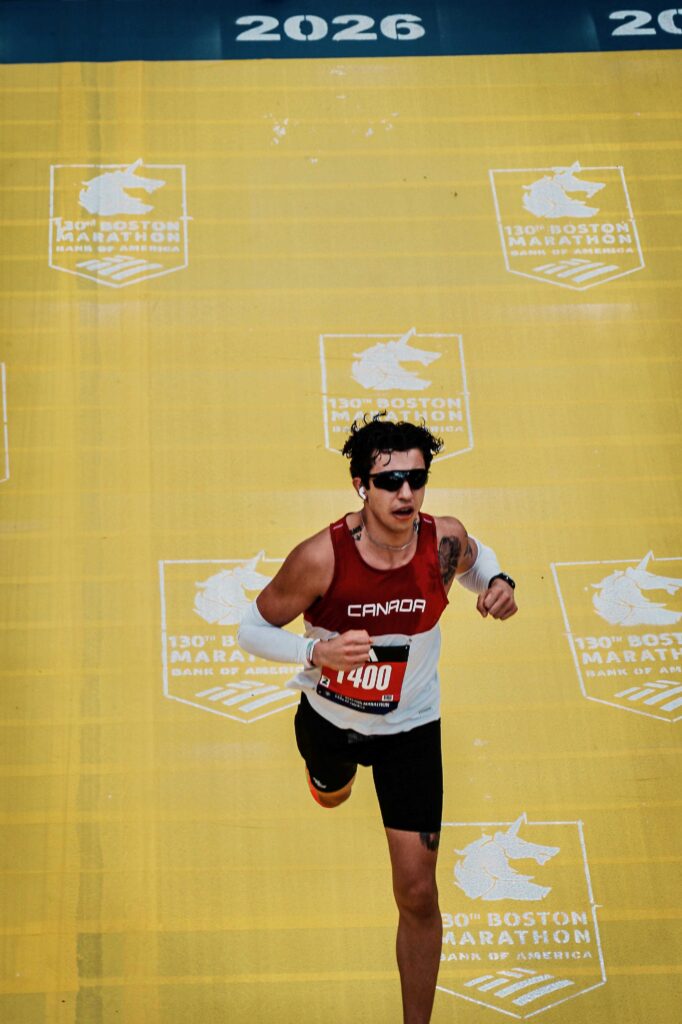
However, the skilled runner had his focus on the 2026 Boston Marathon with a desire of achieving a 2:33 or a better time, embarking on an intensively training schedule.
“I ran a 2:39 marathon at the end of October 2025, and then I started to train. My coach put up a plan for Boston, by mid-December and when I was on my Christmas break….we started to train for Boston. So, all of January, February, March, and then a bit of April….it was following this training schedule [while] going to school. I motivated myself to workout harder, or run longer…reminding myself what I wanted to achieve in Boston. I was also focused on eating clean and going to sleep on time. That meant saying no to friends when there was a social gathering. Sundays were the days I would do my long run and basically simulate race day…so on Saturday nights I needed to be in bed early to prepare for the next day. I had to make these sacrifices, and go through these tough parts of training in order to get where I wanted to be,” he reflected. “I told myself I had to put in this work, and I’m worth a 2:33 time. And come race day….my body and my body felt good. I knew that today was the day to make it happen. I also thought of last year’s Boston Marathon. I wasn’t happy with my time there. After a year, I was back here, with a goal in mind. I had a great race day. I got some advice from Rick on how to run the Boston Marathon. It’s a very difficult course…with several hills…meaning you have to be able to be strategic and pace yourself according to the terrain. Knowing that Rick ran this course before and ran a 2:33, I had to speak with him before the race and figuring out how to run smart. Of course, I did a lot of hill training back home around Niagara Falls….along the Niagara River. I would run up Clifton Hill and Murray Hill. These are very big hills…so that helped train me for Boston.”
After finishing the marathon, someone had then given Jamison the original 1907 Boston Marathon trophy that Longboat won, providing him an unforgettable memory.
“It was surreal experience…being able to hold that trophy and kind of just imagine what it must have been like for Tom Longboat at that time when he won Boston. It just must have been quite a moment for him. When I held that trophy after running the Boston Marathon…it really was a special moment…I could feel energy there…and I felt inspired [and] thought to myself if my great grandfather could win something like this…what are the possibilities for me?” Jamieson said.
And now, the dedicated runner will be looking to the year ahead.
“When I crossed that finish line in Boston, and I saw that 2:33, time, it was one of the best moments in my life because of all the work I put into it. As soon as the race was done….I called my dad…telling him that I accomplished that goal. Being there, and getting that result gave me the motivation to just keep pushing and believing in myself. Now my sights are set on running a 2:24 time this fall,” he noted.


