

County of Brant Council reviewed an application in regards to a proposed soil treatment facility during its regular Council meeting on Tuesday, June 9, 2026.
In order to permit the solid remediation facility, Greenspace Properties Inc. has applied for a zoning by-law amendment for its 3.96 hectare property, located at 249 Brant Road just north of St. George.
Currently designated as General Employment in the County’s Official Plan, and zoned as Heavy Industrial (M3), the applicant proposed that the land be rezoned to Special Exception, Heavy Industrial (M3-XX).
“The current zoning by-law does not have a definition for soil processing and remediation facilities,” said Lauren Graham, a Development Planner with the County of Brant. “The applicants have provided definition, which includes the temporary storage and/or treatment or processing of dirt, soil, earth, fill, or other similar materials, including tertiary biosolids and other non-agricultural, agriculturally sourced materials for the purpose of reuse. Operation of the use will be in accordance with an environmental compliance approval.”
Graham went on to say that the applicant is also proposing site-specific provisions which include one parking space for 40 square metres for an office associated with the facility, and one space per hectare for all other uses whether enclosed or unenclosed (total of 13 spaces).
The planner added that an Environmental Impact Study has been submitted due to the proximity to existing Natural Heritage features including a significant wetland which sits approximately 70 metres from the subject lands.
Graham also said that land use compatibility is currently being reviewed due to the proximity to existing residential uses
“The proposed use is considered a Class II Industrial Use based on D6 guidelines, which had the minimum separation distance of 70 metres of sensitive land uses, and additional mitigation would be implemented as part of the future site plan control application,” she said.
Adam Layton, an associate principal of the Goldberg Group (the agent for the applicant), added further information about the vision for the property.
Noting that the site was originally a fuel depot that has since been decommissioned the agent said it is largely vacant at this time.
“My client seeks to permit a soil remediation facility, which will really function as the backbone of practically all the development proposals we heard tonight, and the development industry in general across Ontario. This serves as a made-in-Brant County solution to contaminated soil and fill,” said Layton. “Rather than trucking it to London or into Etobicoke, local soil that has been impacted can be brought to the site where it will be properly managed, remediated, and will be cleaned up, so that it can be reused for a variety of uses, whether that is topsoil or any other thing like that.”
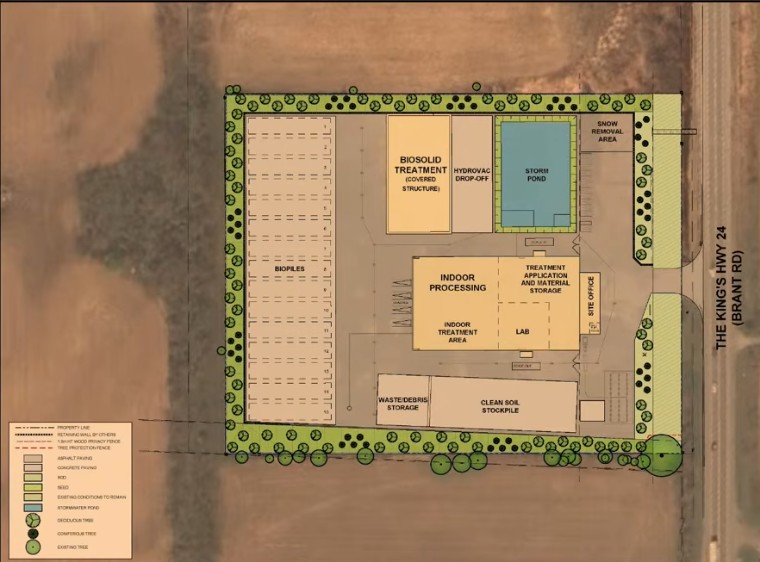
He said the proposal has been circulated for comments to various review agencies and has received general acceptance, however there are some technical matters that need to be addressed at the site plan stage.
“There is an access off of Brant Road into the site. There would be a further gate, an entry gate, leading to a weigh scale, where trucks would be weighed,” said Layton. “They would then dump their loads throughout the site before making their way out through exit gates and back onto the highway. There would be a small office space located at the front of the site, with a parking area located on the northeast, an onsite storm pond, and various covered areas for treatment and stockpiling. The entire site would be paved with an onsite stormwater management system, ensuring that no stormwater leaves the site before being properly treated and cleaned.”
Layton also pointed out that three sides of the site will have a raised earthen berm roughly three-metres in height to help with noise and unsightly views, and that the building would feature about 60,000 square feet of indoor space.
“Only about 300 square metres of that is office and the rest of it consists primarily of an enclosed area for storage of biosolids and other soil,” he said.
Following his presentation, a nearby resident had the opportunity to express his concerns about the size of property for the operation, cleanliness, the smell and traffic.
Councillor Ella Haley later expressed concerns about the smell the facility would create, saying it could be nauseating for nearby residents. She also said that the biosolids sewage sludge is a big issue, expressing she has real concerns with the overall proposal.
Layton stressed that the site will be subjected to an Environmental Compliance Approval (ECA).
“It’s issued by the province with very strict criteria, among them is the fact that odors, noise, dust, anything that can really be considered obnoxious to surrounding uses, must be controlled to the provincial standards at the lot line,” he said. “I would also clarify with respect to biosolids, we are not talking about human waste or sewage, we’re only talking about soil. When we say biosolids, that more refers to, for instance, hydrovac trucks sucking up dirt with water, that would be considered, to my knowledge, a biosolid.”
Layton continued, “The details of the ECA are currently in progress. We’ve had our initial meetings with the ministry that is governing this, and that is the requirement, that all standards must be met at the lot line. With that being said, the zoning by-law amendment merely permits the use, it does not get into the details as to some of these issues that are briefly being brought up. I can say that the devil in the details would be addressed through the ECA and the site plan control stage, which is where a lot of these required mitigation measures would be fully designed and implemented.”
Commenting on the provincial standards, Councillor David Miller said that cannabis production and mushroom substrate rendering all produce terrible smells, and that the County hasn’t gotten any help from provincial ministries with those issues.
“I’m a little jaded when it comes to that, but I’m going to hope that the smells aren’t bad from this,” he said.
Miller also asked about the materials that will be treated at the facility and where they come from.
“We are strictly looking to remediate soil, and that material can really come from anywhere,” replied Layton. “[For example] when you repave a road and you have to scrape a layer of topsoil on the shoulder, that top soil could be impacted by road salt, and that is considered contaminated, that is one of the materials that could be accepted at this facility.”
When Councillor Robert Chambers asked what would happen with the contaminants after going through the process, a Greenspace representative said, “The material comes in, it’s screened and so a lot of contaminants come up with a physical process, and then we’ve developed microbes that eat through the contaminants and dissolve the contaminants so they’re no longer present. So the material sits in windrows and we spray the microbes into the material, it’s then aerated and contaminants disintegrate physically.”
Chambers asked about heavy metals, and the representative confirmed the microbes don’t work on them, but that they would be separated through the screening process.
The Ward 4 Councillor then expressed his concerns about the outdoor storage facility, saying that five inches of rain could lead to further contamination in the surrounding area.
The Greenspace Representative said that the soil being brought will be tested before being brought into the facility, treated and tested again before leaving.
“And to answer your question about the leachate, all the water is contained within the facility,” he said. “Nothing leaves the facility until it passes through the storm pond, and it has to pass the ECA before it is released into the ditch. So that is monitored, and there’s restrictions in place. If there’s a spill or anything like that, we can shut the site off and stop any material from exiting.”
After further discussion, Council voted to receive the application as information only, and sent it back to staff for review.
Many councillors said during the meeting that they’re planning to visit a similar site for further insight on facility operations.
Kimberly De Jong’s reporting is funded by the Canadian government through its Local Journalism Initiative.The funding allows her to report rural and agricultural stories from Blandford-Blenheim and Brant County. Reach her at kimberly.dejong@brantbeacon.ca.


