
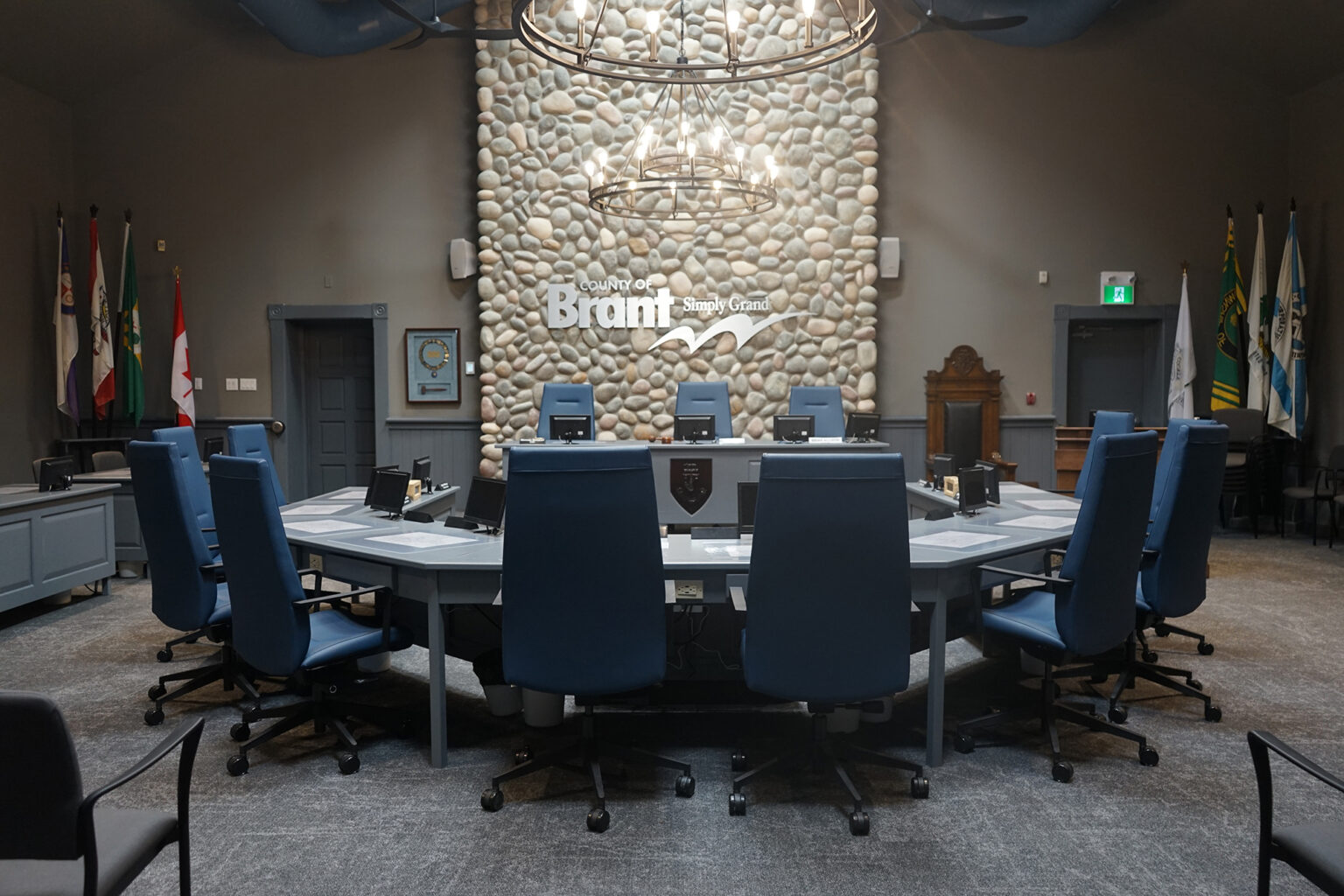
County of Brant Council voted to move forward with the implementation of the new Community Planning Permit System framework during their regular Council meeting on Tuesday, July 28, 2026.
First brought to Council back in October, the Community Planning Permit System (CPPS) is designed to modernize the County’s zoning framework by combining several planning approval processes into one streamlined system.
The CPPS will guide how land is used and developed within the County. Currently, development applications such as zoning changes, minor variances, and site plans are addressed separately, but with the new CPPS in place, it will bring them together under one single framework.
With that being said, building permits will still be required for any construction or demolition of a building or structure.
According to the EngageBrant project page, having the new CPPS means that planning applications can be reviewed more efficiently, with fewer steps, while ensuring community needs remain top priority.
The page goes on to state that the CPPS will essentially help the County:
- Support the goals laid out in the municipality’s Official Plan.
- Secure spaces for community facilities, parks, open spaces and affordable housing options as a condition of the CPP application (meaning in order for a developer to get approval for something like reduced parking, they may be required to provide affordable housing to do so).
- Protect the environment, cultural heritage and archaeological sites.
- Provide great flexibility in development standards and
- Encourage well-designed future development.
The major transformation of the County’s planning system will allow staff to make decisions on routine planning applications, while still allowing Council to oversee more significant proposals.
Having been deferred during the July 9 meeting, staff came back last Tuesday after reviewing received feedback, responded to Council’s questions, and made minor revisions to the final CPP by-law.
“The revisions include updates to address comments from the Grand River Conservation Authority, including clarification of natural hazards, regulated areas, and coordination with conservation authority requirements,” read the staff report. “Additional changes have been made in response to comments raised at the July 7 meeting related to on-farm activities, interpretation, transition provisions, amenity space, aggregates, and implementation of the Facilities, Services, and Matters framework. Staff also completed a final review to correct minor formatting, wording, and cross-reference issues.”
The staff report continues, saying “The CPP By-law will continue to be monitored and refined as needed following implementation. Staff will provide monthly updates to Council through Friday File and will continue to share information with the public to support understanding of the new framework.”
It was stated during the Council meeting that developments that have already been approved under the former planning process, will remain protected under the new CPPS.
“Existing approvals are protected,” said Brandon Kortleve, Manager of Policy Planning. “If a decision has been made on a development, it’s only fair that we carry that over.”
While representatives from the Brant County Federation of Agriculture had addressed Council earlier in the evening and asked for rural and agricultural areas to be excluded from the CPPS for the first two years.
Kortleve and Director of Planning Jeremy Vink both responded saying that running two parallel systems would be more complex for staff, and that other municipalities who have implemented some variation of a CPPS had warned against it.
“One of the main reasons that we are moving towards this CPPS as a unified system is to help simplify planning in the County of Brant. …We’ve heard from other municipalities that have undertaken a CPPS, that operating in two separate planning systems creates confusion. It increases administrative complexity, and it makes future updating difficult because you’re amending twice the amount of stuff you’re amending to begin with,” said Kortleve. “We have had those conversations, and staff are of the opinion that moving forward with one framework is the best choice for the municipality. That doesn’t mean that every area will be treated the same, just as their zoning bylaw contains different standards for different communities, different land uses. The CPPS does exactly that as well. It’s just all contained within a single single planning framework.”
Kortleve went on to say, “From the rural perspective, I would say the CPPS will provide more flexibility. So there are rules, fewer planning applications for people, more certainty for farmers and for rural landowners. It will modernize how we administer planning, not just in urban areas, but also in rural areas, which I think is well deserved to be applied across the municipality.”
While many councillors have expressed their hesitation in moving forward with the new CPPS, stating at times that it was confusing to understand, there was overall support for the system amongst them.
“I really was skeptical, probably more vocally skeptical than anybody else, about a complete revision to what is a familiar, if somewhat inflexible, and in my mind, an abused planning system,” said Councillor John Bell. “…But I think the staff have done a terrific job of preparing the CPPS. Think about the number of steps we’ve gone through as a council. I think this must be the seventh or eighth time Brandon has stood up there and taken us through it. Yes, it’s a completely different system, and yes, we have to learn it. But we don’t have to run it. We’re not rowing this boat. We’re steering the ship, and they’ve done a good job on thinking about the implementation as well. So I think the introduction of a CPPS will be an improvement too.”
Following further discussions and questions, it was ultimately decided to move ahead with the new system.
The approval, which makes the municipality the first to implement the system county-wide, was carried 10 to 1, with Councillor Brian Coleman voting against it.
With Council’s approval, the new system will come into effect on August 22, 2026. Until then, staff will now work toward implementing the CPPS, including transition provisions, administrative procedures, public education materials, staff training, application form updates, and CityView integration.
To learn more about the CPPS, information can be found by visiting the EngageBrant webpage. Staff have also prepared a Frequently Asked Questions (FAQ) document in response to questions raised by Council and the public.
Kimberly De Jong’s reporting is funded by the Canadian government through its Local Journalism Initiative.The funding allows her to report rural and agricultural stories from Blandford-Blenheim and Brant County. Reach her at kimberly.dejong@brantbeacon.ca.


