

County of Brant Council supported an application to permit a soil treatment facility just north of St. George during its regular Council meeting on Tuesday, July 14, 2026.
Submitted by the Goldberg Group on behalf of Greenspace Properties Inc., the application was looking to rezone the 249 Brant Road property from Heavy Industrial (M3) to special exception Heavy Industrial (M3-33) in order to facilitate a future soil processing and remediation site/facility.
The 3.96 hectare property is currently designated General Employment in the County’s Official Plan and is a contaminated brownfield site.
Originally brought to Council for information purposes only on June 9, Development Planner Lauren Graham said then that the current zoning by-law does not have a definition for soil processing and remediation facilities.
“The applicants have provided a definition, which includes the temporary storage and/or treatment or processing of dirt, soil, earth, fill, or other similar materials, including tertiary biosolids and other non-agricultural, agriculturally sourced materials for the purpose of reuse,” she said. “Operation of the use will be in accordance with an environmental compliance approval.”
Graham also said the applicant was also proposing site-specific provisions which include one parking space for 40 square-metres for an office associated with the facility, and one space per hectare for all other uses whether enclosed or unenclosed (total of 13 spaces).
The planner also said that an Environmental Impact Study has been submitted due to the proximity to existing Natural Heritage features including a significant wetland which sits approximately 70 metres from the subject lands.
Additional mitigation measures will be implemented through the site plan control process, and an Environmental Compliance Approval (ECA) will be required with the Ministry of the Environment, Conservation, and Parks (MECP).
Adam Layton, an associate principal with the Goldberg Group, provided further information about the vision for the property during the June 9 meeting.
“This serves as a made-in-Brant County solution to contaminated soil and fill,” said Layton. “Rather than trucking it to London or into Etobicoke, local soil that has been impacted can be brought to the site where it will be properly managed, remediated, and will be cleaned up, so that it can be reused for a variety of uses, whether that is topsoil or any other thing like that.”
During the July 14 Council meeting, Graham said that the applicants had provided councillors with a memo to address concerns from the June meeting, as well as the ECA process.
Having turned down a similar application for 40 Curtis Ave. N. in Paris earlier in the evening, Councillors John Peirce and John Bell said that while the two items were comparable in nature, the soil remediation site was different because of its location.
“Interestingly enough, when you get into the details of this report, this facility is also a hydrovac slurry treatment facility,” said Bell. “Going back to the earlier issue we had on our agenda, why is it different? Why would I think about it differently? Well, there isn’t a Jason’s Wheelhouse or a community health hub next door. It’s an isolated site. I’ve actually been here long enough to remember what the site used to look like when it was used for oil storage. And I think this is a perfectly good use for this site, and therefore I can be very, very supportive of it.”
Both Councillor David Miller and Ella Haley later brought up their concerns with potential odours and Miller asked what the applicants would do to mitigate the issue.
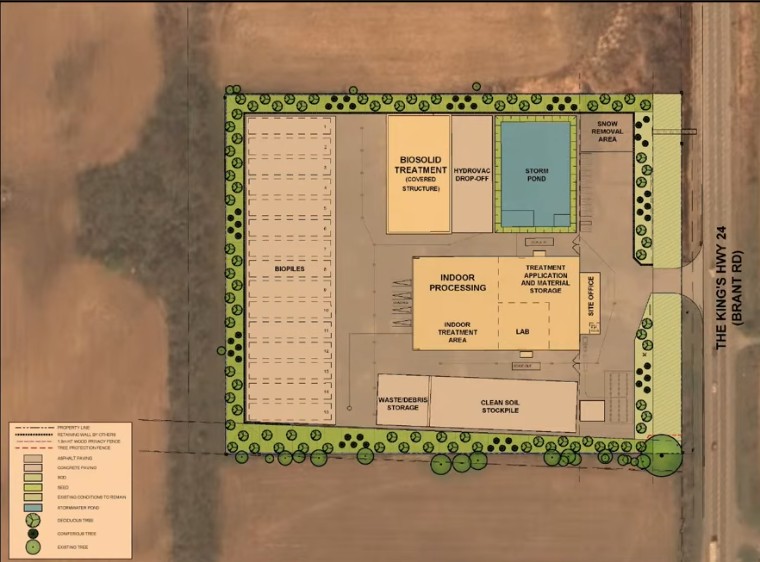
Layton said his clients would use several methods to manage any odours including testing incoming materials for contamination, maintaining separation distances from neighbouring properties, following ECA requirements and best management practices, implementing an odour management plan, and using a three-metre high berm and around 100 trees to help reduce the movement of odours.
Peirce also asked what would happen to any liquids after treatment.
“There is a stormwater management pond on site so water from the entire site is collected within an underground drain system, and directed to that stormwater management pond,” Layton responded. “The stormwater management pond would collect and treat any stormwater or any water that drains from hydrovac, ensure it’s clean, and then control in a controlled manner release the stormwater management into the swale system along Highway 24.
Haley went on to ask several questions, further raising her concerns about potential odours, dust and contamination.
Layton later stated that in order to obtain an ECA for the operation, the applicant would have to meet a set of rigorous standards.
“This site might need up to three separate ECAs. Each would undergo a detailed technical review by multiple branches of MECP and would need to be signed off from various departments considering separate matters,” he said. “That includes groundwater, surface water, air quality, and public health. There’s a very rigorous process, and again, once approved, that forms an instrument or regulation that the province will seek to ensure the Greenspace is compliant with, and again. If, for some reason, they are found to not be in compliance, not only would the ECA be potentially revoked, but we would then no longer comply with our zoning.”
After further discussions, the item was carried on a vote of 10 to 1, with Haley voting against the zoning change.
Kimberly De Jong’s reporting is funded by the Canadian government through its Local Journalism Initiative.The funding allows her to report rural and agricultural stories from Blandford-Blenheim and Brant County. Reach her at kimberly.dejong@brantbeacon.ca.


