
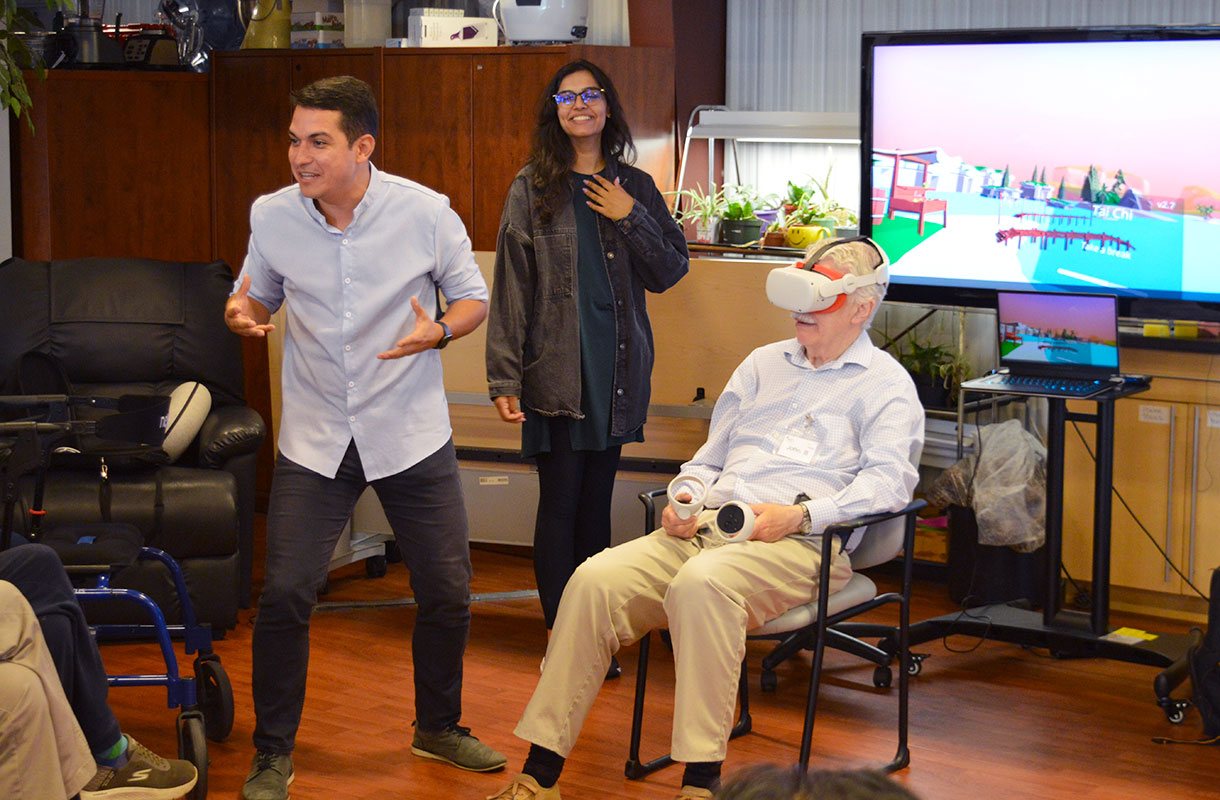
What if virtual reality games could be used to keep your mind sharp and your body active as you age? Well, a professor at Wilfrid Laurier University’s Brantford campus is investigating exactly that.
John E. Muñoz, an assistant professor in Laurier’s user experience design program, holds a PhD in human-computer interaction and completed a postdoctoral fellowship. He also has a background in physics engineering with a master’s in bioengineering. His work at Laurier centres around studying how people interact with technology.
“User design experience is a blend between psychology and technology designers. We look into human behaviour and how people behave when interacting with technology, and then we analyze that and bring it back to the design table. So we design technologies for people and with people.”
During his two years at the university, Muñoz put together and leads the BioAdaptive Interface Research Lab.
“The kind of research we do here is bio adaptive. That means we use different types of body sensors and connect them to interactive systems like apps, games and simulations, and we allow the system to interpret the data and adapt the content based on what we record,” he explained. “A classic example of this is to imagine that you are in a simulation where the world is calm and trying to relax you: the more calm you are, as measured by a heart rate sensor like a small watch, the more dynamic the virtual environment becomes. For instance, it might start snowing or raining as a way of reinforcing that you are actually relaxed. Those are the types of systems that we build here.”
“In particular, I’m very interested in the role of these technologies, which are generally considered serious games or applied games, in health,” continued Muñoz. “I work a lot with training simulations as well, but really, much of the work we do here is exploring the role of those games in areas such as exercise promotion among older adults, or therapy for children with autism and ADHD.”
The professor went on to say that while the students that make up his lab team come from different academic backgrounds and programs, they’re united by shared research goals.
“The kind of students I recruit here come from all over the place, from psychology and health studies to game design, user experience design, computer science and biology too. I even collaborate with people in criminology,” said Muñoz. “One thing they all have in common is they’re very keen to conduct research in this area, but they all have different ways of approaching the work. So what I think is really beneficial and enriching is that when they come here for group meetings and to conduct this research, they learn from each other. Sometimes even more than what they can learn from me.”
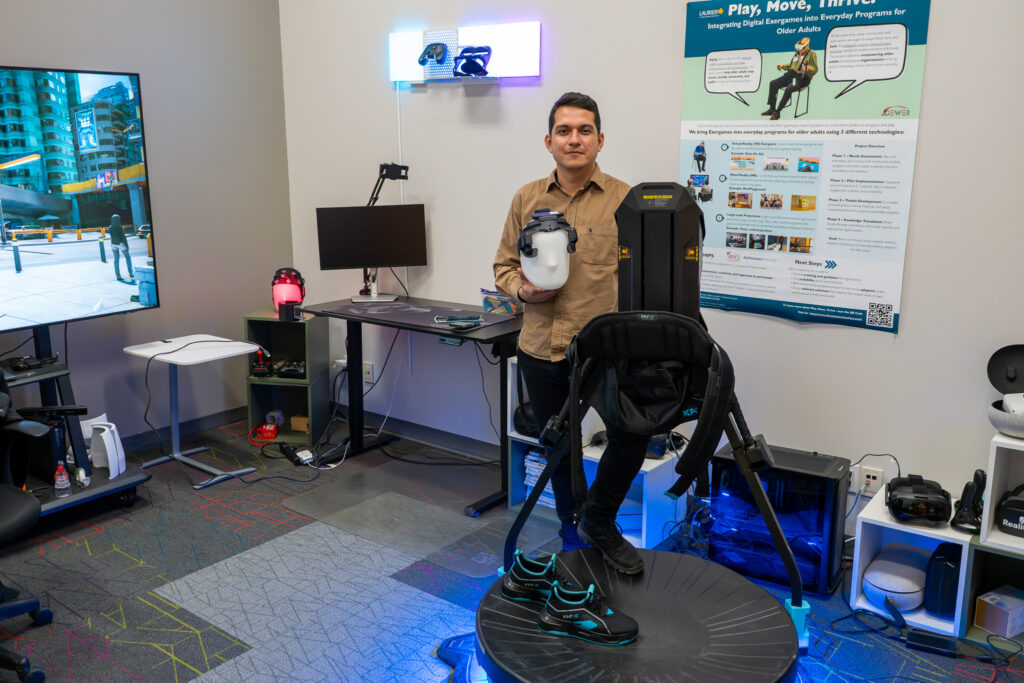
Much of the team’s work centres around developing “exergames,” video games designed to empower older adults to stay active while having fun.
By using virtual reality headset to transport players to scenic locations, games like Seas the Day allow people with physical disabilities or even dementia, to row a boat without leaving their seat. All they need is a virtual reality headset and two controls.
“What the game does is it virtually transports participants and promotes exercise while they remain seated. It’s a 15-minute experience where they begin in front of a lake beside a cottage where they do a little bit of Tai Chi for stretching,” explained Muñoz. “They then have to get onto a boat and row out onto the lake and do some fishing. And from the data we have collected from this 15 minute experience, participants are able to reach moderate levels of physical activity, getting 300 repetitions of rowing in a seven minute duration. But the best thing is, they’re having fun while doing it too.”
He said that when it comes to designing interactive games like Seas the Day much of their work revolves around the team getting out into the community and getting input from the potential users themselves.
“It’s not that we meet here in the lab and then we internally design something that we believe is going to work for them. No, we work with them. What we do first is we do a deep dive into their habits, their routines and we talk to them about their preferences,” said Muñoz. “We ask them if they play any video games, and nowadays you will have some people here in Canada that will tell you they do play those cognitive games or card games, but most older adults aren’t necessarily doing that. But we ask them those things and see what they already play, and then we ask them what kind of activities that they miss or wish they could do, and we take some of this information and we build games.”
While Seas the Day was built during Muñoz’s time at the University of Waterloo before the pandemic, he has since secured funding from the Alzheimer Society of Brant, Haldimand Norfolk, Hamilton Halton, and partnered with Brantford’s Adult Recreation Therapy Centre to officially trial and run a feasibility study of the game with older adults living with dementia.
And although virtual reality can’t exactly replace real life experiences, the assistant professor said it has the ability to give people an immersive alternative for those who may not have access to other experiences.
“For some people, it is a way of distracting themselves by going elsewhere and doing something that is completely different. For some of the people, they are very competitive, and so they want to do things properly and complete every challenge that is there,” said Muñoz. “But for both of those types of players, we are achieving the goal, which in the end, is getting them engaged in something they wouldn’t do otherwise. Of course, if you can go for a walk, you would prefer to go for a walk outside. Or if you can go to a cottage and be with family, of course you would prefer that. But we’re talking about people who wouldn’t be able to do those things if they didn’t have this option of a virtual experience, which tends to be very immersive and generate this feeling of physical presence that other technologies cannot do.”
Muñoz went on to say that despite some older adults being more hesitant to try virtual games, some see the potential value.
“I think for the ones that see the value of doing something that is physically encouraging, but also mentally engaging, they see the value of sticking with it, and they have fun while doing it. And I think when somebody has that positive reaction, it tends to make other people enthusiastic and it gets them thinking of whether or not this will be able to help them with their condition,” he said. “But the truth is, we don’t know [if it will help the], and that’s why we’re investigating. We don’t know if these types of systems and embedding them into the communities, will be able to slow down the cognitive decline process. There’s research that shows that it is feasible, but it’s just very preliminary. What we do know, and what has a lot more evidence, is that physical activity is overall, very good in mitigating and preventing many elements related to cognitive decline. So for now, that’s the angle we’re approaching this from; keeping older adults active.”
As well, Muñoz and his team are currently recruiting people for two different types of studies. One for independent older adults, taking place at the lab, and the other for those diagnosed with dementia or mild cognitive impairment, taking place over ten weeks.
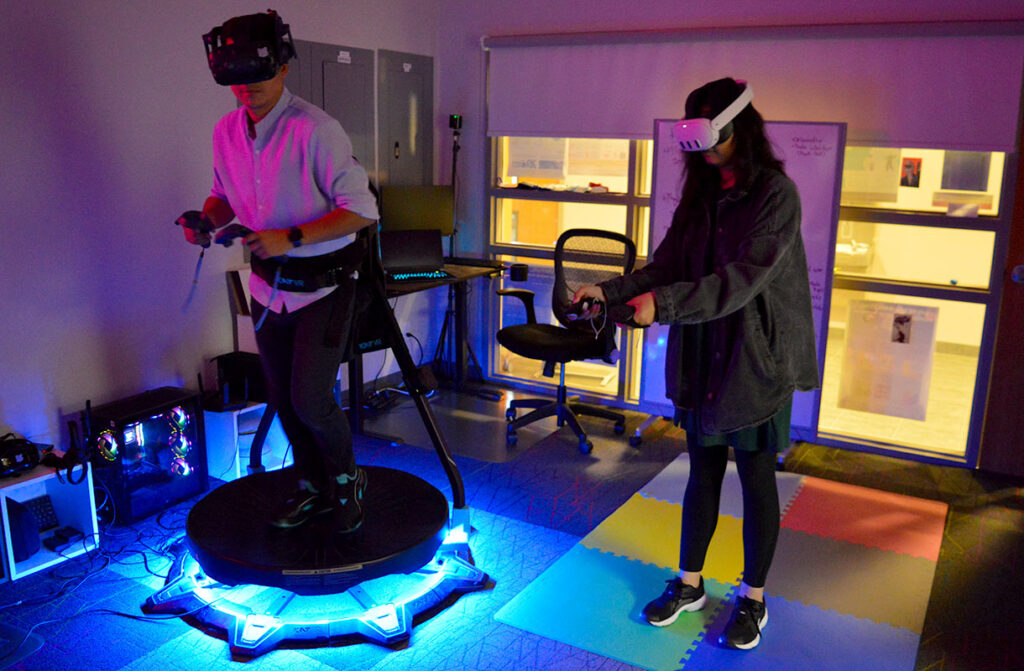
“One is, I always invite independent older adults to come to my lab and try things that we’re doing. Right now we’re currently building virtual tours of the Ontario parks to allow people to use an omnidirectional treadmill to walk during and explore during winter or if they cannot access those things,” he said. “We’ve started with Algonquin Park to see if people like it and we connect heart rate monitors and all the sensors for measuring the impact of the exercise associated with that. So if you’re an older independent adult, please feel free to shoot me an email at jmunoz@wlu.ca”
“The second one is we’re currently running a study involving older adults diagnosed with dementia or with mild cognitive impairment to be part of a 10 week program that involves multiple assessments of cognitive aspects and physical activity,” continued Muñoz. “I know that doesn’t sound that exciting, but the fun part is they will get to play a lot of the games that we have crafted specifically for this population using virtual reality.”
Kimberly De Jong’s reporting is funded by the Canadian government through its Local Journalism Initiative.The funding allows her to report rural and agricultural stories from Blandford-Blenheim and Brant County. Reach her at kimberly.dejong@brantbeacon.ca.


