
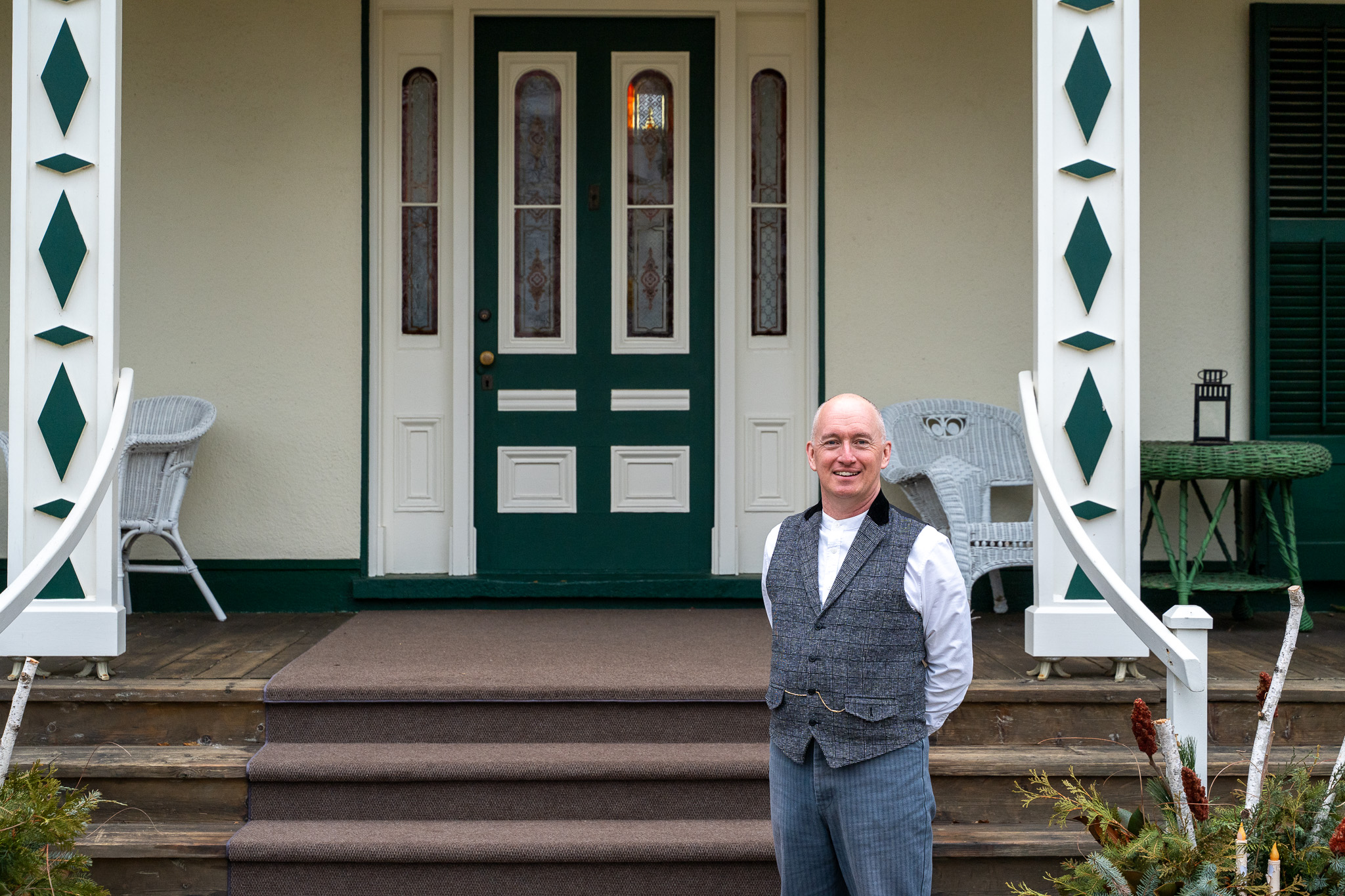
After 37 years working at the Bell Homestead, Brian Wood led the first of his final six tours of the National Historic Site on Wednesday, January 14, 2026.
It was announced on January 6 that the longtime curator would officially be retiring at the end of the month after nearly four decades at the homestead.
To honour his dedication and commitment, the Brian Wood’s Last Call Bell Homestead Tour and Tea welcomed residents, out-of-town visitors, longtime supporters, and even former employees to tour the historic site alongside the curator one last time.
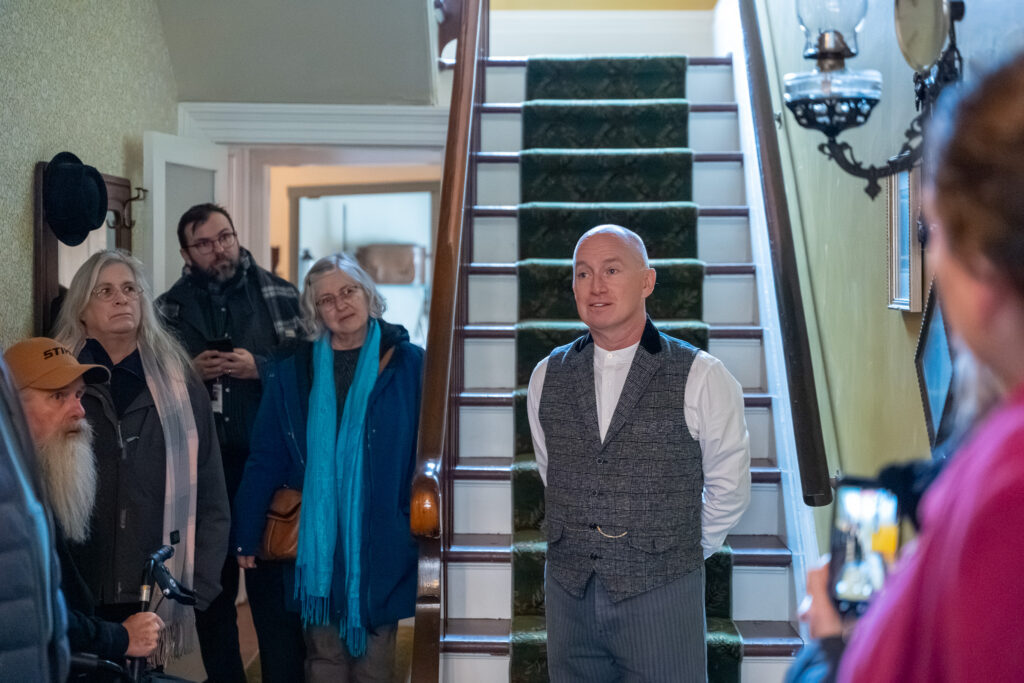
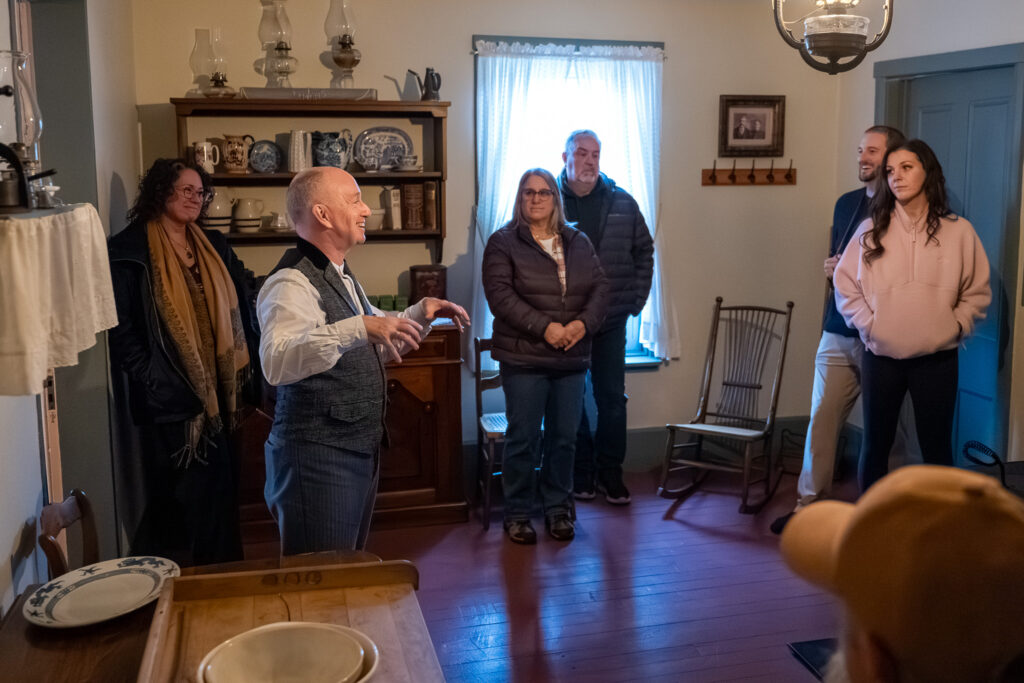
Moving through the first level of the Bell family home, Wood shared various pieces of information and anecdotes about the family, their preferences and their achievements.
“Welcome to what the Bell family called ‘Melville House’ through the 11 years that they lived here. …Alexander Melville and his wife, Eliza, purchased this home in 1870 after emigrating from Scotland in the hopes that the changing climate would better their son’s health. Alexander was 23 at this point and appeared to be showing signs of tuberculosis, which both of his brothers and nephew had died of back in Scotland and in England,” explained Wood. “His father, having been to Canada in his youth, knew that the air was much cleaner and much drier here, and so he wrote to a family friend who, at that point, was living in Paris, Ontario, and asked him for ideas of where they might settle.…They were the second owners of this property, and for $2,600 they purchased this house, a ten-and-a-half acre farm, two-and-a-half acres of fruit orchard at the back, and they were raising almost 60 animals a year here, almost entirely for their own food.”
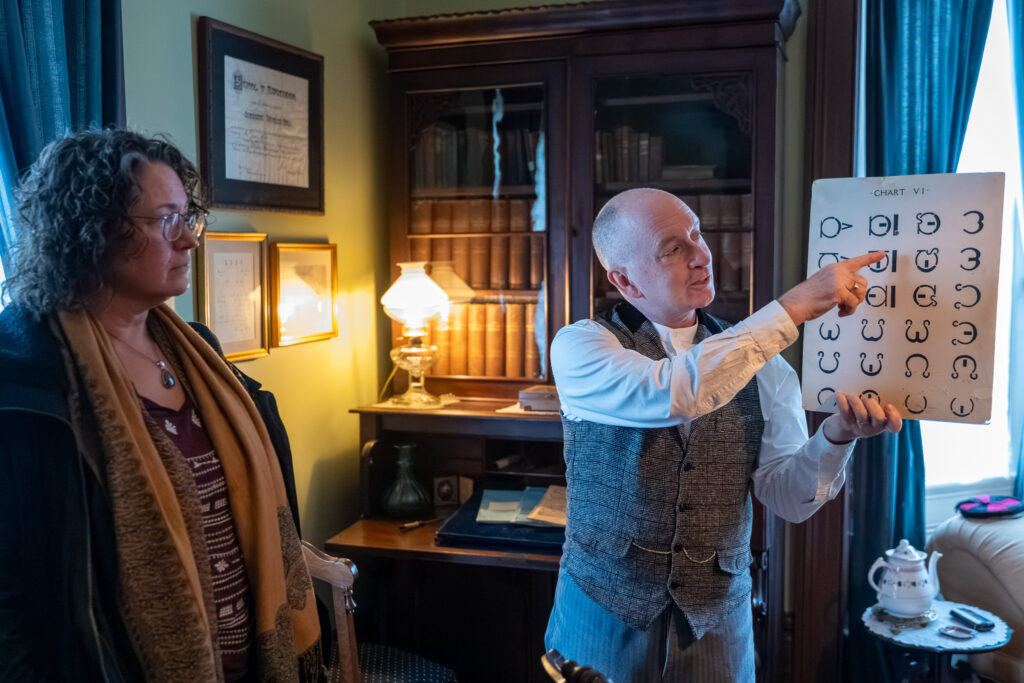
That first year, Alexander spent much of the fall and winter resting and helping his parents settle into rural life, but was soon offered a teaching position with Boston School for the Deaf in Massachusetts the following spring, said Wood.
“He would spend fall and winter in Boston, and then in the summer, he would come back to Brantford and spend two months with his parents as well as the holidays,” he said. “It was here with his parents that he discovered the basic principle for the telephone in July of 1874. July 26 is the date he would tell you he invented the device, and would also claim that was the day he conceived the idea.”
Starting in the main foyer, Wood guided guests into the library where he pointed out some of the tools Melville used to teach his students, his favourite place to lounge, as well as some of Eliza’s original paintings and sketch books. In the dining room, Wood spoke about the family’s eating routines, Alexander’s preference for plain chinaware, and what the curator believes to be one of Eliza’s best paintings; a photo of her three young sons back in Scotland.
He also touched on the work Alexander did at the home in Brantford in 1875 and 1876, including writing patents and testing his invention, first across short distances and then over longer ones.
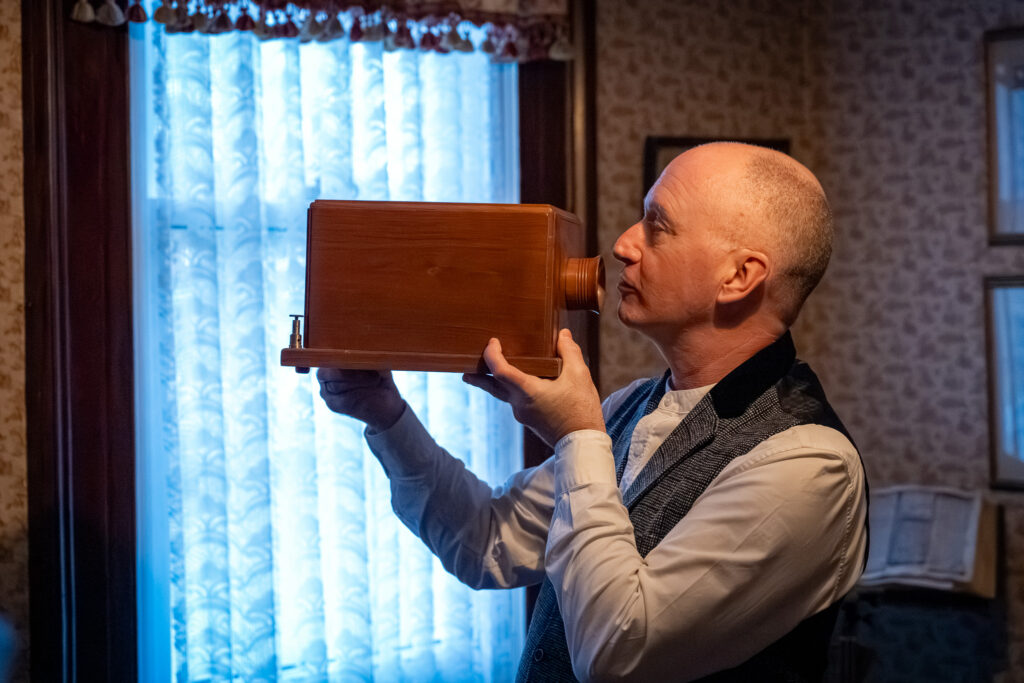
Over in the kitchen, Wood talked about the home’s wood-burning stove as well as tedious laundry days, while in the drawing room, the curator discussed Eliza’s choice of decorations, different family heirlooms, and how guests were entertained.
Wood also spoke about how Eliza lost her hearing at the age of 13 and Alexander’s different efforts to communicate with his mother, as well as the early beginnings of the inventor’s relationship with his wife Mabel.
“When Alec was 11, Melville challenged him to come up with a way of speaking to Eliza without her hearing trumpet. Alec did some experimenting with his mother and discovered that if he pressed his lips against her forehead and spoke in his normal voice, she could understand what he was saying–not from the sound–but from the vibration,” explained Wood. “So even as a boy, he was already learning that every sound is a vibration. As he got older, he learned more about speech while working with his father, and, of course, more about sound. He came to the conclusion that even someone born deaf could be taught how to talk by showing them what sound looks and feels like all through vibration.”
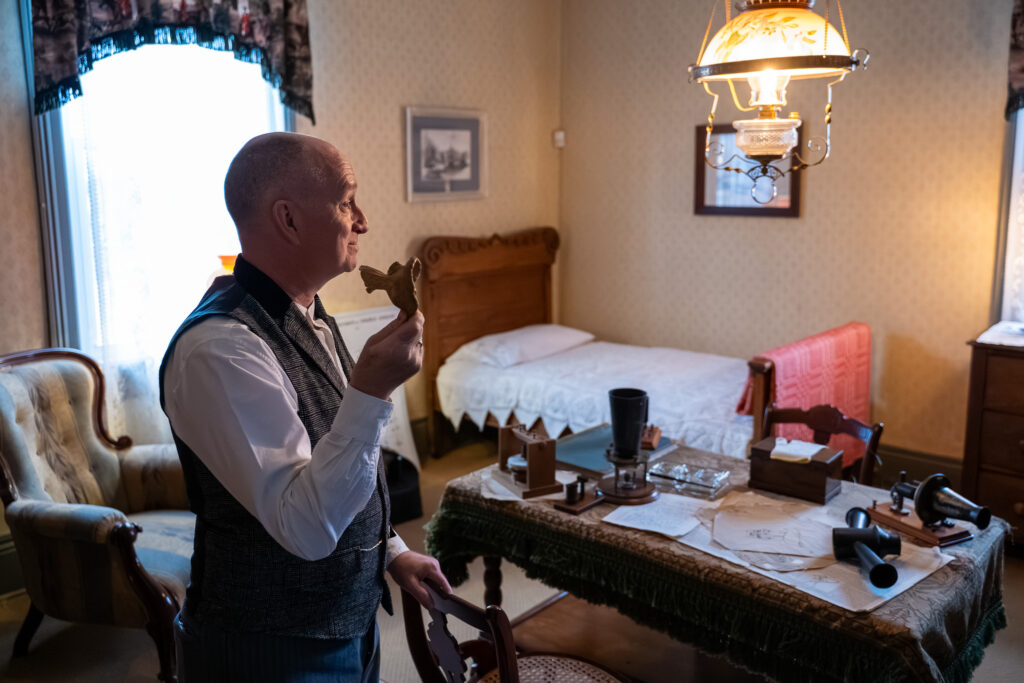
Before heading upstairs to view the four different bedrooms, the guests first got to see what had been Alexander’s room, as well as a few of his early prototypes for the telephone.
After finishing up the tour of the Melville House, Wood led the group over to the Henderson House, Canada’s first telephone office.
“This little house was not here in the Bell family’s time. It was moved here from downtown Brantford in 1969 to be part of the museum, because this is where the Bell Telephone Company of Canada started in 1877,” the curator said. “…That same year, Alec was granted a Canadian patent for the telephone and immediately gave it to his father in the hopes that Melville could start a telephone business here in Canada. Alec and his future father-in-law and associates were doing the same thing in the United States and Alec hoped that Melville could get the same thing going here. …So from 1877 until 1880, this is where you came to lease your telephones and pay your telephone bill.”
Wood went on to discuss some more early models of the telephone, as well as Canada’s first version of the switchboard. Ending the tour on more of a modern note, the curator also spoke about how telephones continued to change and improve from the 1950s and onwards, including the invention of more colourful models.
Finishing up the event, the group then headed over to the Exchange Cafe for a variety of snacks and tea.
Janet MacMillan, who worked at the Bell Homestead as a university student in the 1990s, shared fond memories of working with Wood during his early days at the museum, even before he became curator.
“He’s always been a fantastic person to work with and for, and we’ve kept in touch over the years. I’m just really happy and excited for him as he goes into this next stage of his life,” she said. “He mentioned the legacy that he wanted to leave behind was renovating the Henderson House, but honestly, from when I started to where the Homestead is now, the difference is night and day. It’s just fantastic to see it as this living historic home as opposed to just a museum.”
She went on to say that it was neat to take part in one of Wood’s last tours, and what stood out to her the most was how much is still being discovered.
“What stood out for me today was that, even though the history we’re talking about happened so long ago, they’re still discovering new pieces of it. There’s new pieces of furniture and new things that they’ve discovered through letters; I love that, even though it happened a long time ago, we’re still discovering and learning about it, and it’s evolving, and a lot of that is because of Brian,” MacMillan said.
Since stepping into the role in 1995, Wood has been a driving force in shaping the Bell Homestead into a recognized cultural destination, and in preserving the legacy of Alexander Graham Bell and his family.
The curator is responsible for introducing curriculum-based educational programming for school field trips, day camps and as an overall destination for learning. He’s also the reason many visitors get to enjoy different events at the site such as the Summer Music Series, Summer Theatre Festival, Candlelight Christmas tours, the Halloween Fun Fair, Eliza’s Mother’s Day Afternoon Tea and more.
Under his leadership, he got the homestead designated as a Canadian National Historic Site in 1997, a milestone which was formally recognized with a visit from the late Queen Elizabeth II.
Wood also obtained and preserved the original Bell family letters and oral histories, which not only served as the basis of four published volumes of My Dear Aleck: The Selected Letters of the Bell Family, but played a key role in restoring rooms within the family home to accurately interpret what the day-to-day life of the Bell family would have looked like in 1870s.
Taking it one step further, Wood also managed to acquire many original family artifacts from descendants of Alexander and Mabel Bell. Some of these items included personal effects, furniture, sketchbooks and portraits painted by the inventor’s mother Eliza, and ivory miniatures. Most recently, he led the re-design and installation of the museum’s new modern telephone gallery inside the Henderson House for the 150th anniversary of the telephone.
Kimberly De Jong’s reporting is funded by the Canadian government through its Local Journalism Initiative.The funding allows her to report rural and agricultural stories from Blandford-Blenheim and Brant County. Reach her at kimberly.dejong@brantbeacon.ca.


