
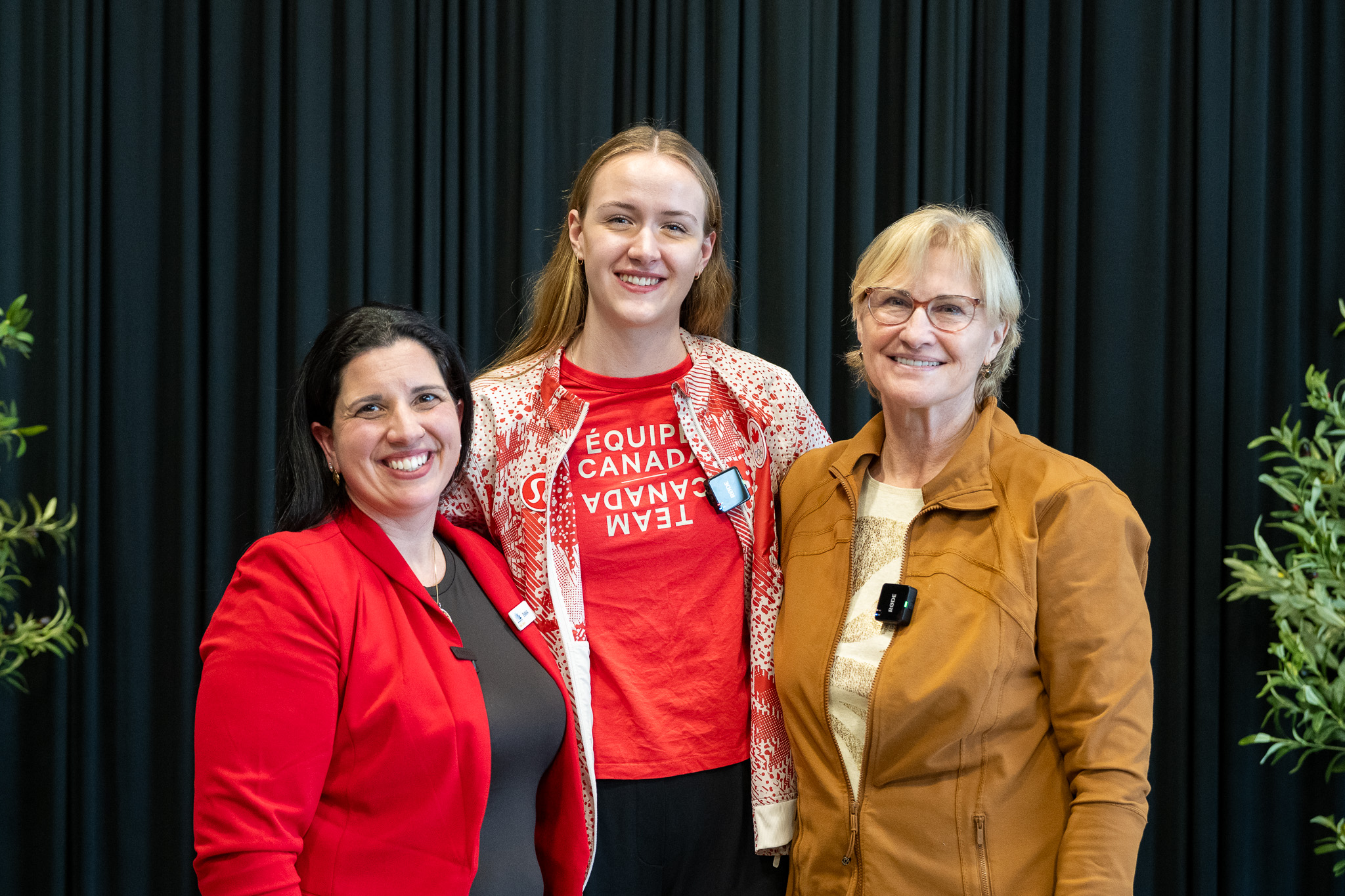
Nearly 40 people attended the County of Brant Public Library’s most recent programming, titled Unstoppable: An Olympic Celebration, on Sunday, January 18, 2026.
Emma Johnston, who handles the library’s program and outreach services, said the panel-style event was designed as a way to help get the community excited for the upcoming 2026 Winter Olympic Games and to promote athleticism at every stage of life.
While three Olympic athletes were originally set to be in attendance, including Garrett Riley, Angela Schneider and Claire Scheffel, Riley was unable to participate as he was under the weather.
Kicking off the event, Johnston introduced each of the athletes, starting with Schneider.
“Dr. Angela Schneider is a professor of kinesiology and director of the International Centre for Olympic Studies in the faculty of health sciences at Western University in London, Ontario” she said. “She was Director of Ethics and Education at the World Anti-Doping Agency (WADA), and president of the International Association of the Philosophy of Sport. She was also former assistant dean for ethics and equity at the faculty of health sciences. Angela won an Olympic silver medal for rowing in the women’s coxed fours at the 1984 Olympic Games in Los Angeles, California.”
Scheffel was then welcomed up to the front and introduced to the audience.
“Claire is a local athlete living in Brantford who started artistic swimming at the age of seven,” said Johnston. “She has competed in the Paris 2024 Olympic games, the Canada Winter Games, Pan American Games, many World Cup events, as well as four World Championships, traveling the world with both provincial and national teams.”

Johnston then began a panel-style question and answer period where she asked the athletes everything from how they got involved in their respective sports, to the character traits they had to develop to get where they are now.
“I think for me, the biggest two traits are patience and perseverance,” responded Scheffel. “I think it’s really easy to forget when you see people competing at the Olympics, all of the work that they put in. You really can’t make an elite athlete without work and time, and you might spend years and years doing that, and still not be able to accomplish those goals. So really, just being patient with yourself, being kind to yourself, and putting in the work.”
When asked about what memories stood out most about the Olympic games, both of them brought up the opening ceremonies.
“It was going out there and realizing [that there were] all these Canadians that were behind us, and seeing them in the stands and cheering us on. … I also realized at that moment that, ‘wow, I’m an Olympian, oh my gosh, I’ve been thinking about this since I was ten’ … it was just fantastic, ” recalled Schneider. “The second thing was the Olympic village and the actual ability to have that cultural exchange and understanding of the other athletes that are there …You have an understanding of what it took to get there, and even though you cannot speak to them [because they often speak another language], you can share that understanding, and that’s really something.”

Johnston went on to ask the athletes about what it was like to take part in a team sport, what they wished people knew about high-level sports, and the hurdles they had to overcome.
“For me, a big one would be all the sacrifices. I know growing up, especially since synchronized swimming is such a unique sport, people didn’t really understand why I was at the pool so much. My friends would be asking me to hang out, but I would have to say, ‘Sorry, I have practice,’” said Scheffel. “It’s very time consuming and I didn’t have a lot of time for extracurriculars, so growing up, I felt very not normal, and that was very hard for me. Then once I did make a team, I had to move to Montreal, which was a very amazing experience, and I’m very grateful I took the leap, but it was so hard to be away from my family and away from my fiance.”
Schneider had similar sentiments and added that another big hurdle for her was the financial aspect, noting that it was a Grade 9 gym teacher that lent her the money to go to the Olympics, as well as her local legion who donated $500 for her ore.
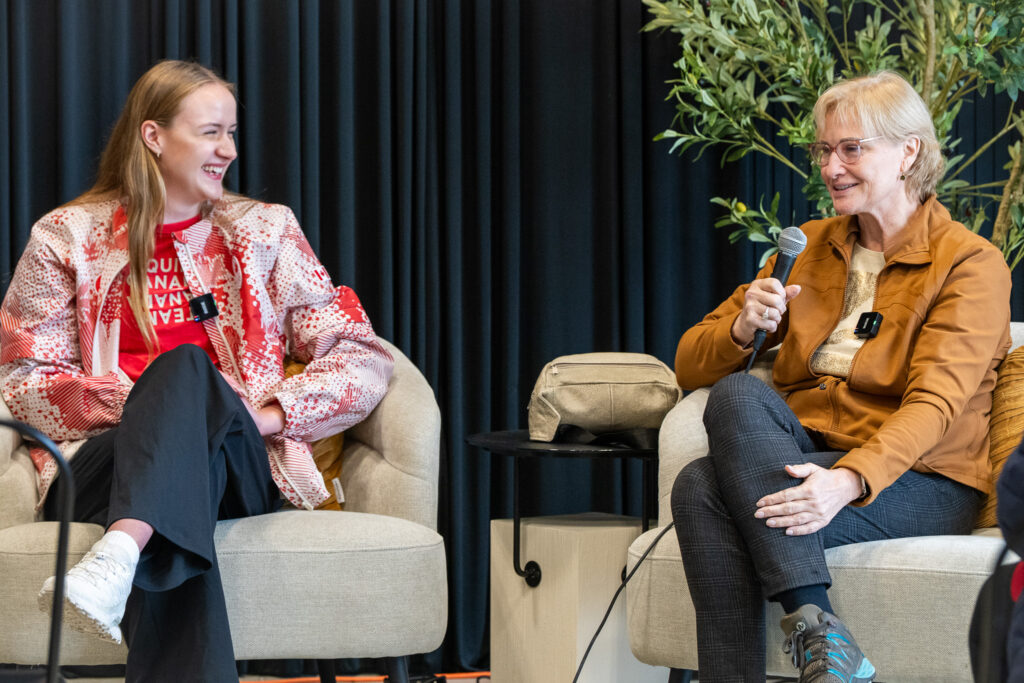
As far as what advice the two could offer to young athletes, Scheffel and Schneider recommended that the youth find their love of sport and to find the joy in putting in the effort.
“I think that young athletes need to find their love for their sport, and I think it’s really important to remember that the reason you love the sport doesn’t have to be the same as everyone else’s reason,” said Scheffel. “I’ve spoken to my teammates on the national team and prior, and we all have different reasons. I like finishing and the feeling of being done, the accomplishment, and being with my team and celebrating those wins. … I think it’s important to remember that if the reason you love it isn’t the same as someone else, it’s not wrong. But I think it is very important for you to find that reason and make sure you’re doing it for yourself.”
“It’s not about the end goal, it’s about how you get there and the things you learn on the way,” added Schneider. “…It’s got to be about enjoying that process and about learning about yourself.”
Following Johnston’s questions, those in the audience also had the opportunity to ask their own questions. Some touched on overcoming adversity in sport, what kind of support was missing for Canadian athletes, how they could get youth involved in sports, their favourite travel experiences and more.

Kimberly De Jong’s reporting is funded by the Canadian government through its Local Journalism Initiative.The funding allows her to report rural and agricultural stories from Blandford-Blenheim and Brant County. Reach her at kimberly.dejong@brantbeacon.ca.


