
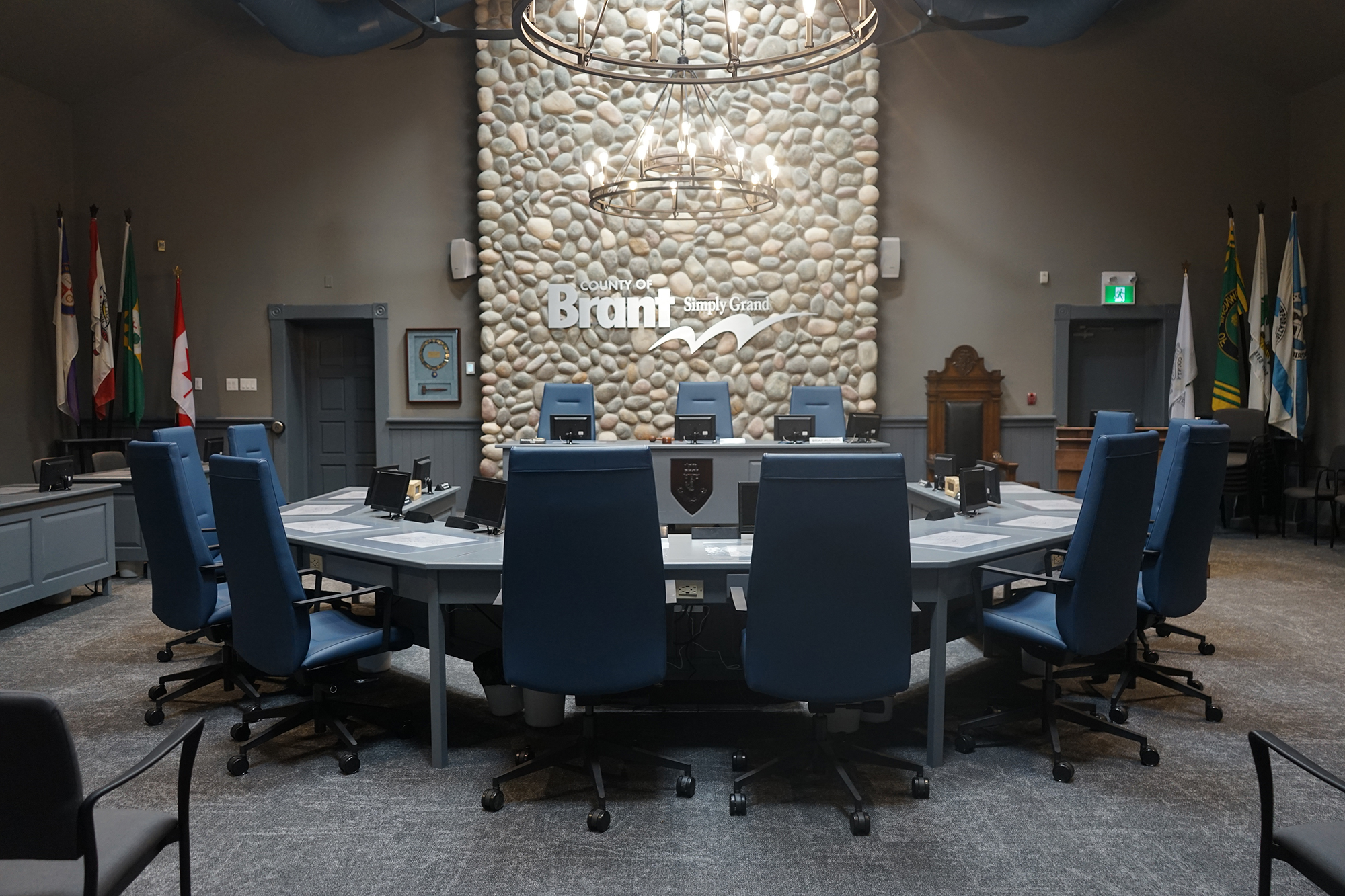
County of Brant Council is moving ahead with a five per cent tax increase for 2026.
The budget is divided into two categories. The operating budget funds day-to-day costs to ensure the municipality can continue to deliver services to residents, while the capital budget covers major investments and the maintenance of the County’s assets, including roads, infrastructure, parks, facilities, new equipment and amenities.
Property taxes remain the County’s primary revenue source, accounting for 58 per cent of funding. Use and service fees make up 33 per cent, while grants and subsidies from other levels of government account for nine per cent.
The budget process began with a review of the County’s long-term financial plan, a ten-year forecast showing the municipality’s expected revenues and expenditures. The plan is used to guide any decisions related to growth, service and capital investments.
The County also collected community feedback to help shape financial priorities.
Inflation, population growth, new projects and updates from the Master Plan and studies were then reviewed, and a draft budget was presented by the mayor, allowing council opportunity to make comments and propose any amendments to the budget before its finalized.
This year is the first time the County of Brant’s budget was prepared under the province of Ontario’s expanded strong mayor powers, which directed Mayor David Bailey to present the budget to rather than Council working on it together.
While the powers give the mayor the authority to change the budget and veto council amendments, Bailey made it clear while presenting the 2026 Mayor’s Budget on January 22, that he had no interest in using them.
Bailey said that the 2026 budget was entirely based on the long-term financial plan, which was unanimously approved by Council in December.
“What I’ve done is open up the Long Term Financial Plan so I could do the budget and present it as my own, but I used all the information that was done by my council,” he said. “I have no interest in being a strong mayor and using my strong mayor’s power, so this was the only way that I could get complete buy-in from my council. So this is my budget to council, but it is your input that drove me to put it down and I know that everything in this budget is okayed by my council, because it was okay unanimously.”
In the end the presented budget included an operating budget of $70,555,892 and capital budget of $21,901,684. The figures represent an overall levy increase of five per cent after assessment growth.
Of that five per cent increase, one per cent is being dedicated to a special levy for the new Brantford-Brant hospital project.
This means that for a median residential property assessed at $391,000 (as determined by 2016 data from the Municipal Property Assessment Corporation), there will be an annual tax increase of $206.28, or $17.19 a month.
“Council does not take proposing a five per cent tax levy increase lightly, however additional investments are necessary to maintain, repair and replace aging infrastructure and assets, to support our emergency responders and to meet the need for increased at-reach supports and services,” said the mayor in a statement. “Fulfilling a local contribution commitment towards the New Hospital Project is essential to the success of this project, which is a critical need for our community and represents a tremendous investment in our region.”
According to County budget documents, key cost drivers include staffing costs, inflation, growth and other adjustments, an increase in contribution from the contingency reserve, a higher capital levy, increased provincial operating grants, rising OPP costs, an increase in paramedic services, and increased funding for external agencies.
During the January 22 meeting, Councillors John Peirce, Brian Coleman, John Bell, Robert Chambers and Lukas Oakley, all said they supported the budget, many of them commending the mayor for keeping them involved.
“We just got back from ROMA and I was talking to a lot of people from other municipalities who are dealing with the reality of strong mayors, and a lot of them have been feeling less engaged, and less involved in the budget process,” said Oakley. “I’ve said it multiple times, but I want to just praise you, Mayor Bailey and staff, for creating a process that keeps us as involved as possible. I know there will be some people who will read this mayor’s budget, and whether they like it or don’t like it, will put it all on you, but this is a group decision. If someone’s taking the fall for it, it’s all of us, not just the mayor, because I think this is very reflective of what we all voted on.”
Peirce did however say that the only real issue he had with the budget was the median residential property being assessed at $391,000.
“I don’t know what antiquated numbers we’re still using from MPAC [Municipal Property Assessment Corporation], but to me, that does not paint an appropriate picture for the public,” he said. “These are 2024/2025 numbers I found online for the County of Brant, and it states that the median price for a residential home is anywhere from $700,000 to $1-million.”
His concern was that some people would read the budget expecting a $206 increase to their taxes, and be surprised when it was far higher down the road.
Heather Boyd, General Manager of Corporate Services, clarified that the $391,000 reflects the assessed value of the home, not the market value, and it was later agreed that staff would find a way to communicate it to the public.
Following an extensive question and answer period, staff said that the next step would be for Council to bring forth any amendments to the budget by the February 5 special Council meeting.
During that meeting, staff went over some clarifications about the 7.9 per cent increase to staffing costs, noting that it did not represent just individual staff earnings but rather:
- An iIncrease related to the Community Paramedicine Program, which was not previously reported as part of the budget process, but represents both an increase in costs and an offsetting revenue amount.
- Increases related to annualized costs of positions approved mid-year in the 2025 budget.
- Increases to union and non-union salaries/ wages in accordance with approved contracts and policies, and
- Increases in benefits costs not related to enhancements.
Chambers later wondered why several projects around roads, specifically in Oakland and Scotland had been pushed to 2027 and 2029.
David Mellor, General Manager of Operations, explained it was because the County is still waiting for the Scotland-Oakland master environmental servicing plan to be completed, noting that they didn’t want to invest money into rehabilitating the streets just yet in case they needed to put in other infrastructure.
Following more discussions, it was later noted that because there weren’t any major amendments to the budget, it would officially be adopted on February 15, 2026.
Kimberly De Jong’s reporting is funded by the Canadian government through its Local Journalism Initiative.The funding allows her to report rural and agricultural stories from Blandford-Blenheim and Brant County. Reach her at kimberly.dejong@brantbeacon.ca.


