
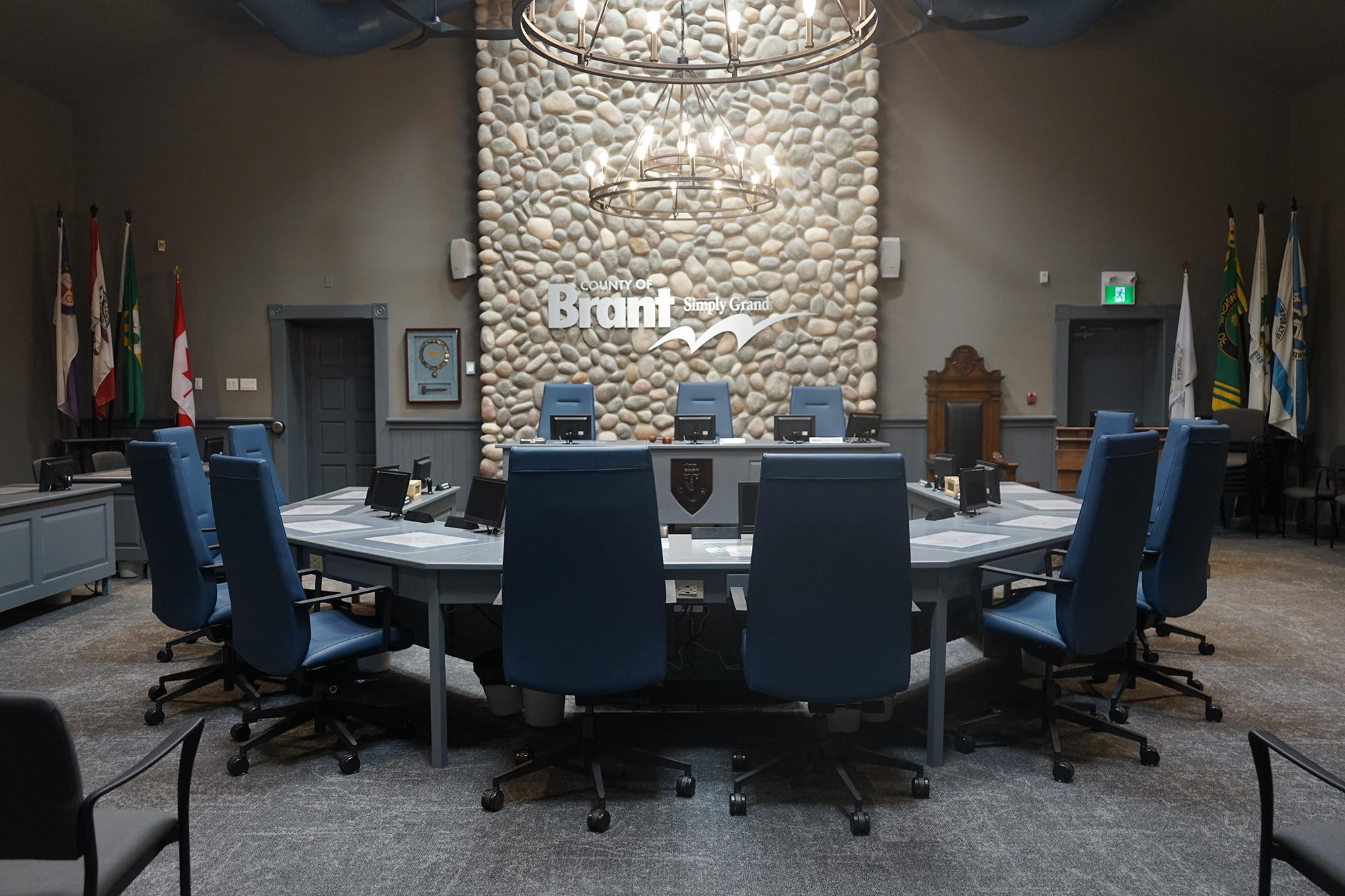
County of Brant Council will further discuss its Long Term Financial Plan (LTFP) during a special council meeting on Thursday, December 18, 2025.
The 213-page draft plan, which was first presented during a two-hour special council meeting on Thursday, December 4, includes an estimated 4.7 per cent property tax increase for the average home in 2026 (down from the earlier forecaster 13.6 per cent). The increase reflects an expected eight per cent rise in overall spending, partly offset by new residential and industrial growth, which will bring in more tax revenue.
Alison Newton, the County’s CAO, said the LTFP is intended to provide clarity for decision making, provide a framework for prioritization of needs, and to assist Council in balancing current service demands while preparing for future growth and challenges
“This tool will empower staff to provide thorough analysis to Council in order to balance competing priorities, to act with foresight, and to ensure choices both fiscally and strategically aligned with the broader needs of our community,” she said. “The direction given by Council will be built into the plan and will assist Mayor Bailey and staff in preparing the 2026 budget presentation in January.”
Heather Boyd, the County’s General Manager of Corporate Services, said the LTFP is essentially a collection of various financial documents and tools that have been compiled into one document, which will be reviewed and improved each year.
“The long term financial plan is a compilation of all the policies and procedures that Council has approved, budget directions that have come from Council, decisions that impact future revenues and expenses, the major studies and plans that various departments have done all throughout the year that feed into the County’s long term financial goals, and looking at any new initiatives or funding requests for the next year,” she said. “It’s taking all the work we’ve done and basically putting it into one document. What happens after the 18th is, we’ll take the decisions Council makes and finalize the document so we have a financial plan document that will be reviewed again next year.”
Boyd said the plan ultimately aims to create a balance between the County’s finances and what the residents can afford, while investing in health, safety and emergency services, maintaining the County’s infrastructure and key assets, and reflecting public feedback.
Noting that 216 people participated in a public engagement survey conducted from November 6 and November 25, Boyd said residents had the opportunity to share what mattered most to them.
While the results showed varied public opinions on a number of issues and projects, several common themes emerged from the survey including: concerns about affordability and tax increases, both in the past and proposed for 2026; concerns about residential growth, especially related to traffic and servicing capacity; support for increased investment in existing assets but especially roads; and support for the new hospital project.
These themes are highlighted in more detail in Boyd’s 107-page 2026 budget engagement summary.
“Respondents want safe roads, reliable infrastructure, responsive emergency services, and visible progress on the Brantford Brant hospital project. They want more support for affordable housing, rural communities, transit, and services that help them move through the County safely and efficiently,” explained Boyd in the report. “There is also clear concern about the pace of growth. Many feel that development has moved faster than the infrastructure needed to support it and that rural and smaller communities have not received the same level of investment as fast-growing areas. Respondents expect growth and developers to carry more of the financial burden.”
Her summary also notes that the scattered results from the engagement survey show there is a lack of budget familiarity. For example, many respondents asked for major infrastructure upgrades while also calling for zero tax increases.
“Only 11 per cent of respondents understand how the municipal budget works. This explains many of the conflicting expectations in the data,” read the report. “People want major investments in infrastructure, health care, growth management, and community facilities. At the same time, they want low taxes, reduced debt, and higher reserves. Many residents are reacting to day-to-day experiences rather than to the funding rules, tradeoffs, and provincial limits and regulations that shape local budgets.”
Boyd said because of this, there is an opportunity for the County to build public education around the budget and how things are paid for, as well as things like the pace of growth being mandated by the province.
Following the lengthy overview of the LTFP, councillors had the opportunity to ask questions about funding the hospital, how the tax levy went down from 13.6 per cent to 4.7 per cent, the equity of spending throughout the wards, tax increases compared to other municipalities, affordable housing, the engagement survey, capital expenditures and more.
The reports will later be received as information and the LTFP will be discussed in further detail on Thursday, December 18, 2025.
The next day, in a social media post to Facebook, Councillor John Bell addressed all the work that goes into budgeting for a municipality, and encouraged his followers to take the time to read the LTFP in its entirety.
“There are some in our community that question the ability of County staff and Council to develop financially sound plans and budgets,” he wrote. “Read the report and you will begin to understand the complexity of managing an organization with an operating budget of over $117 million, a capital expenditure forecast over the coming ten years of over $700 million, a rapidly growing population, a land area of 820 sq km comprising predominantly rural lands but with a number of urban centres, over 2000 km of roads; I could go on! Our staff do a great job in managing this complexity and are always working in the best interests of our community.”
Kimberly De Jong’s reporting is funded by the Canadian government through its Local Journalism Initiative.The funding allows her to report rural and agricultural stories from Blandford-Blenheim and Brant County. Reach her at kimberly.dejong@brantbeacon.ca.