
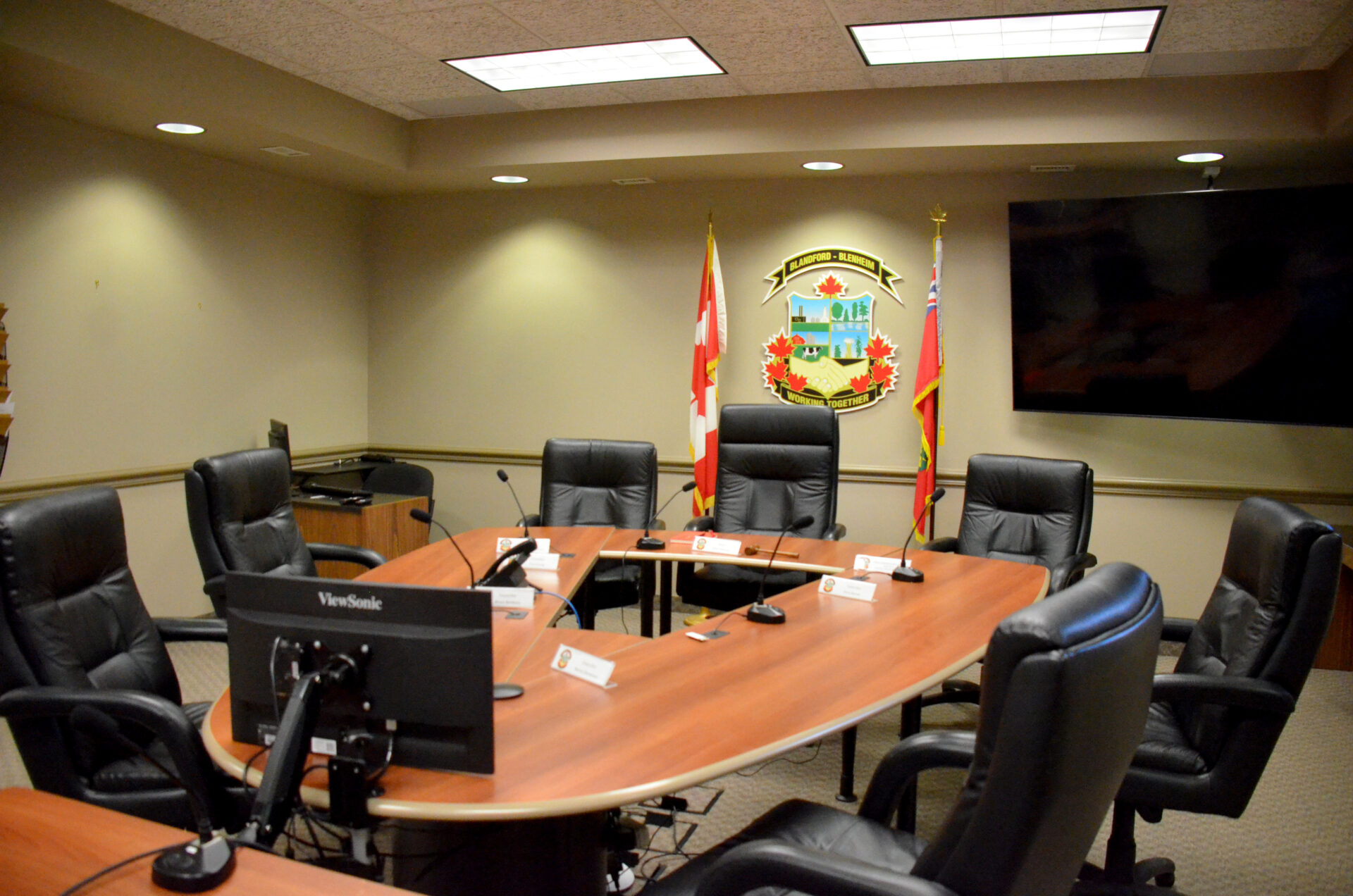
Township of Blandford-Blenheim Council approved the use of bio-resin on Township Road 12 during its regular meeting on Wednesday, July 8, 2026.
Township Road 12, between Trussler Road and Blenheim Road, is set to be converted from a gravel road to hard surfaced road this year.
In 2025, the 1.2 kilometres of the road was reconstructed by adding material through a low area that was prone to seasonal flooding. The material was placed in layers and compacted along the way, raising the road profile by 1 to 1.2 metres in some locations.
Rather than converting the road to hard surface right away, the reconstruction project was left over the winter so the material could go through various freeze and thaw cycles.
Jim Borton, Director of Public Works, told Council this practice is normal and allows staff to monitor for any soft spots or problem areas before the final hard surface is applied.
“Whenever we do this type of construction, we like to let it sit at least through one winter of the freeze-thaw cycles,” he said. “This gives us the opportunity to monitor and determine if we have any issues on that road section, and we did find in the springtime, a couple of soft spots on Township Road 12 that we had to raise.”
Although the affected areas have since dried out and the spots have cleared up, staff are concerned if the conversion to hard surfacing is done without any mitigation work, the road may not stand up to Township standards and will require further repairs in the future.
“As that road is scheduled to be converted to a hard surfaced road this year, we certainly don’t want to leave it to have issues and have problems ongoing,” said Borton.
Staff have since explored other options to address the issue.
“The traditional option is to dig out the soft spots and add more material,” he said. “I don’t have it in the report, but we would be looking at a cost of approximately $150,000 to $200,000 to have that work done.”
Another option is to use a bio-resin developed by BioDiffusion Technologies Inc. (BDT). The product is designed to add strength to a road base at a lower cost ($65,000 plus HST) than adding gravel.
According to Borton’s report, “BDT has done more testing and proved that it is a reliable and safe option. BDT bio-resin strengthens existing road base—without adding height—delivering 60 to 100 per cent strength gains. In many cases, this allows you to reduce aggregate or asphalt requirements while improving performance. The bio-resin is sprayed onto the existing road material and then graded to ensure that the coverage gets into the material. The road is then compacted, as the bio resin dries it strengthens the road base. Tests have shown that the longer the bio-resin is down, it gets stronger. It can be driven on within a few hours of application and can be paved over or surface treated.”
Borton explained to Council that because bio-resin is still new, many are hesitant to buy into it, but that upon further review of data, staff believe it will strengthen the road base.
“It is a new product and not many people have done it. Lots of people like the idea of it, but unfortunately, it’s hard to get people to step up and actually try it,” he said. “I thought in our application, this 1.2 kilometre section would be a good spot to try it. The price is relatively good, it’s half to a third cheaper than if we go the traditional route to dig it out and add new gravel, which is what their large selling point is.”
Borton added that the Township staff can apply the bio-resin themselves, and that BDT will continue to monitor and test the area.
Following his presentation, Mayor Mark Peterson asked whether paving the road could lead to an increase in truck traffic.
“We do have a gravel pit on that road but that section is still seasonal road limit restricted, so they should be using Blenheim Road. We’ve seen a lot of traffic on it now, which I’m sure has packed it down even more with Bridge 23 being closed for the deck repair,” replied Borton. “I can’t say there won’t be truck traffic on it, but probably not to the extent that there is now. There should be no issues with the extra weight running across that road.”
Having noted earlier that the Township of Puslinch and Township of Centre Wellington have both tried bio-resin base stabilization, Councillor Nancy Demarest asked if Borton had the chance to speak to anyone from either municipality about the material.
“North Wellington was at the Good Roads conference, and I did speak to them,” he replied. “Since their initial test, which was one kilometre, they have done three other kilometres of road, and are working it into their regular maintenance reconstruction because they see the value.”
While a majority of Council were skeptical about the new material and how it would work, even discussing putting down the bio-resin and letting it sit for a year to see how it hardens, the item was ultimately approved at a cost of $65,000 plus HST.
Kimberly De Jong’s reporting is funded by the Canadian government through its Local Journalism Initiative.The funding allows her to report rural and agricultural stories from Blandford-Blenheim and Brant County. Reach her at kimberly.dejong@brantbeacon.ca.


