
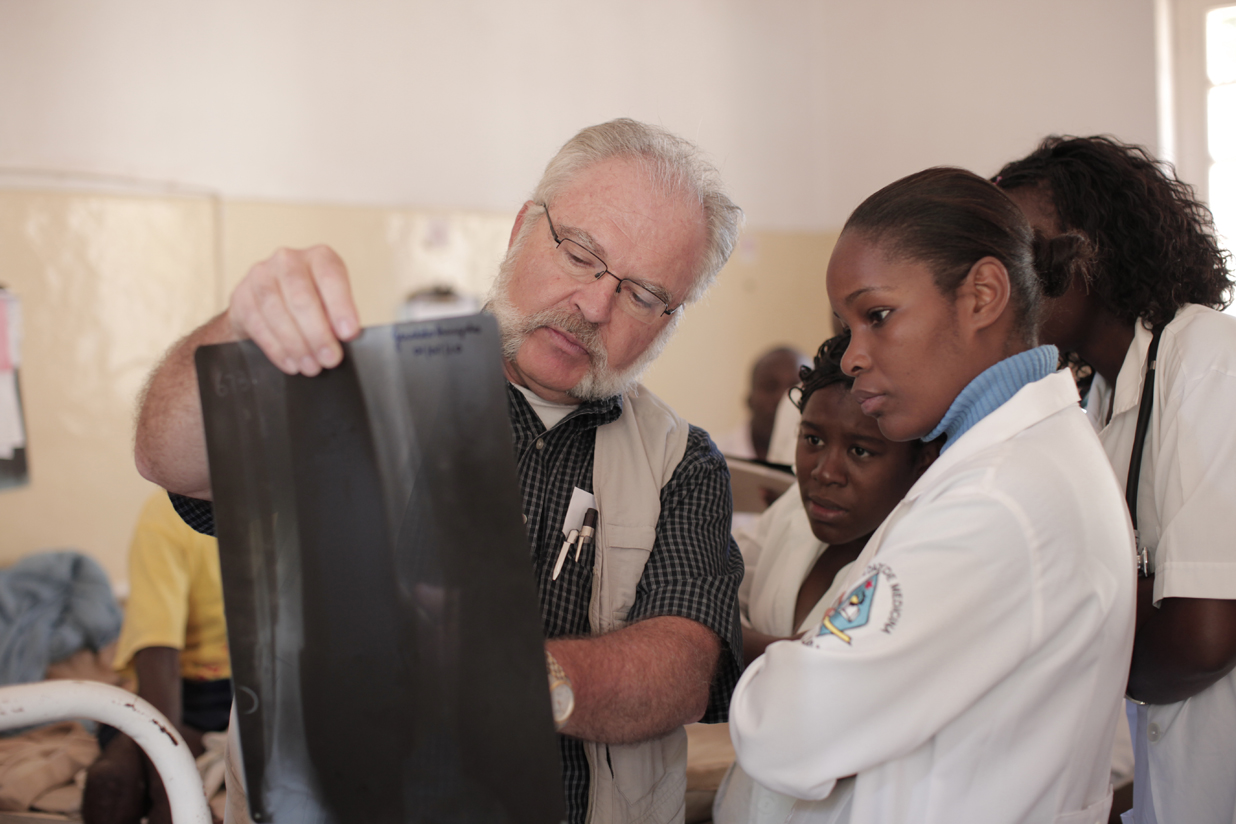
For close to 50 years, missionary-surgeon Stephen Foster has been instrumental in empowering local clinicians through training, advancing maternal health and fistula care and serving as Medical Director of CEML (the Evangelical Medical Centre of Lubango) in Angola.
Dr. Foster, who was born in Brantford, was exposed to his parents’ missionary work very early on.
“My parents heard that there was work to be done in the country of what’s now Zambia. I went as a nine-month-old baby with them [and] grew up there. I then came back and lived a few summers in Brantford..with family, working construction. But in Zambia…I lived in a place called Mukinge in the northwest province there. My dad built a hospital in the region…where my grandparents were (and had gone there in 1917). My granddad had started translating the Bible into the local language, which was Kikaonde. He ended up translating both New and Old Testaments, and so in many ways my first memories were those of grandparents steeped in local language and my parents developing this mission rural hospital, which was the first hospital in the Northwest Province, about 300 miles from any city,” he said.
By his early 20s, Foster developed an interest in surgery, eventually making a home in Angola.
“I got bit by the bug of rural medicine, and wanted to serve people in that capacity. I ended up discovering my parents had moved from Zambia to Angola in 1970. I was a medical student at McMaster in Hamilton. They were experimenting with things like international electives, and I got the privilege of going to Angola to find that out my dad starting yet another hospital in central Angola, which had been previously a leprosarium for leprosy patients….and turned this hospital into a general one, which would serve everybody….I would then get interested in surgery…came back to Canada, and got into the general surgical training program of the University of Toronto…becoming a head-to-toe kind of surgeon.”
However, when he committed to coming back to Angola, he would witness the effects of colonial rule and civil war.
“One of the complicating features of Angola…is because the Portuguese had been there for 400 years… isolating the people from much of the rest of Africa…[and] trying to keep some sense of the power game alive, and notwithstanding the attempts by…Russia, China and America [who] all had an eye on the country…because of diamonds and oil. Angola became a playground for the big powers as they fought a 27-year civil war,” Foster said. “We witnessed the war going on, because we were some of the few that were willing to work in rural Angola….where the war was being fought by landmines and ambushes, and the kinds of ugly things that go on when nobody has the upper hand. It wasn’t until the early 1990s that a ceasefire came, which led to elections…but then the dispute about who won it took ten more years until peace [came into being], and it wasn’t until 2002 we began to see what peace might look like.”
There were also lessons being learned through the years, and helping train others to help.
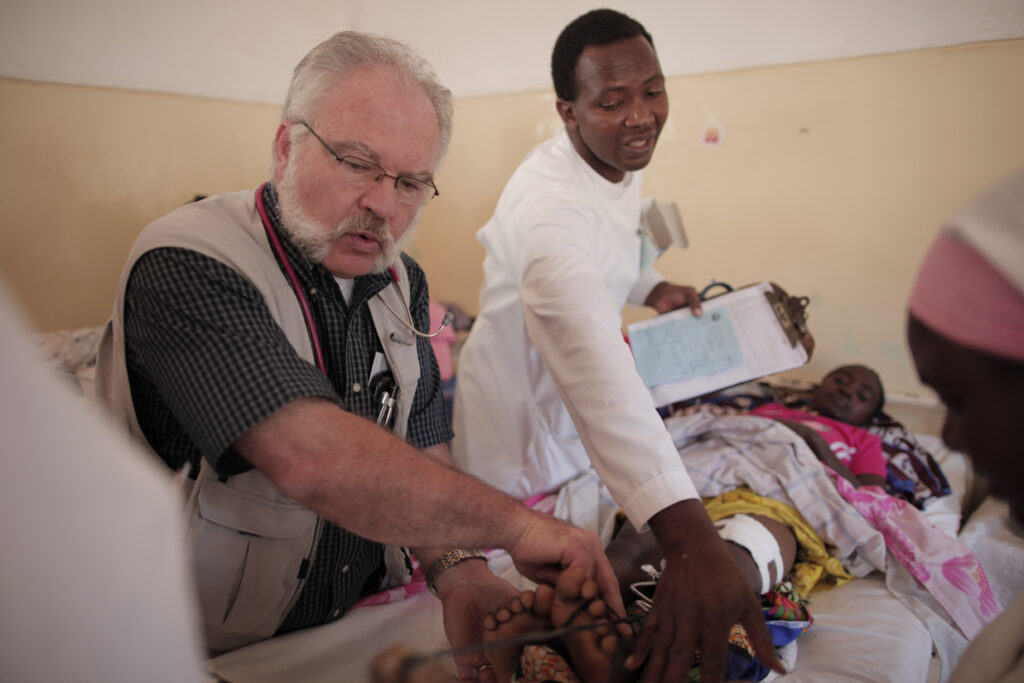
“One of the big things I discovered was that if you didn’t take sides…you treated everybody the same. Notwithstanding what uniform they were wearing, or what language they were speaking, or whether they were calling you comrade….you simply treated everyone…their families, and their wives. Everyone got equal treatment [and] you ended up earning the respect from people who were enemies on paper with one another. So we found that the best way to stay and work in that kind of confusion was to not take sides and simply serve in the middle.” he stated. “I also discovered that some of those nurses there and people with grade four to eight education on paper did good work. I developed nurses who could do cesarean sections for me [and] others who could do skin grafts…take out broken teeth, and could clean up the wounds from landmine injuries, and they could help me do four times the amount of work that I was able to do by myself, and consequently, as the sole surgeon, when we were having 2,000 or 3,000 patients come through the operating room…more than two thirds of that work was done by my nursing staff, and one of the ongoing lessons in life has been that we doctors have a bucket load of pride about how we need to be providing the care for people exclusively…And when you practice medicine in North America, you tend to think about putting yourself on the top of the heap. Well, when you practice medicine in Africa, where you’re a scarce commodity, you find that if you’re going to care for people, you better find ways to share your skills with other people, and have them have the fun of seeing many people get better and get helped.”
Nevertheless, Dr. Foster refined his skills to focus on an important procedure, obstetric fistula, helping women in the country lead normal lives.
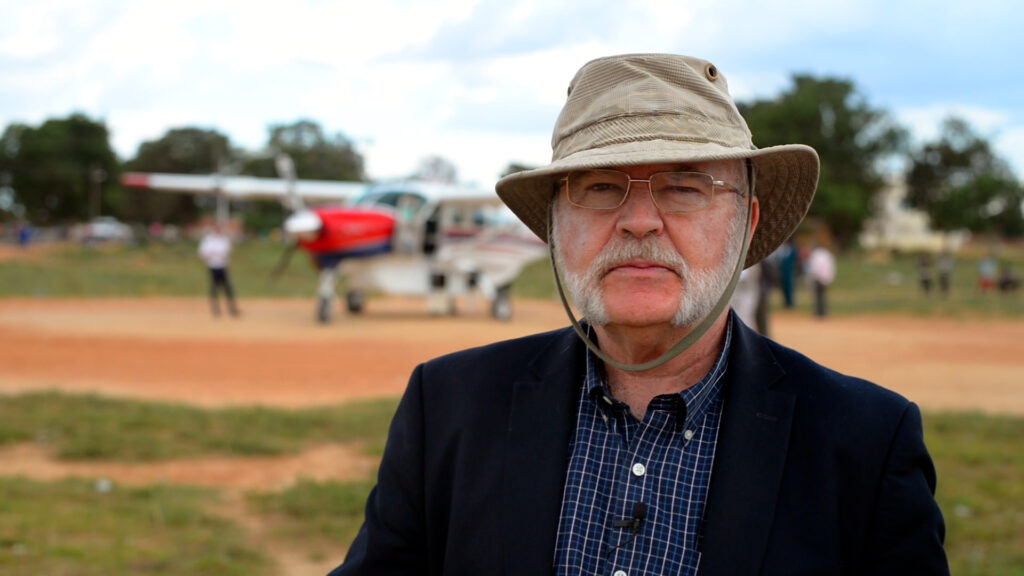
“Somewhere between one in eight of every birth attempt needed a Cesarean section…and a reality for many Angolans…is that they don’t have access to an operating room or theater, or maternity, or anyone who has the skill sets to make a cesarean section with modern operations. The consequence of not having it is either they die or they develop this devastating injury, where they lose control of their bodily functions…they become people who are shunned, isolated, and pushed out…to be forgotten,” Foster stated. “I’ve personally operated on over 1,000 women over the last 15 years. It’s mind-boggling to see what happens in the change when you cure them….they can go back home, and they can even consider reestablishing life, and some of them are able to have children again. If they can get a cesarean section, and…so the whole challenge we face is getting that message out…we’ve had the privilege to have some of our patients going back to their villages…and spreading the news that there’s hope, and they can get to live normal lives again. We’d like to think that Canadian women would want to get involved in this and donate. Because these procedures help these women. A Cesarean section costs at our hospital for around $200 to $250 and these gifts really take off a huge financial burden off the shoulders of these women.”
However, a milestone for Dr. Foster and his team, has been the 20th anniversary of the CEML (the Evangelical Medical Centre of Lubango) and the importance of the work they have been doing.
“It was basically founded around the question, ‘Could and would Christians in Angola get their act together, and instead of simply talking about the love of Jesus on Sundays?’ It’s actually practicing the love of Jesus Christ every single day in practical terms…could they, would they get together, [and] put their hands on the wheel, and actually build a mini hospital where we could act and carry out the life giving and life preserving and life saving surgeries that would give opportunity for men and women to hear and see and taste the love of Christ in palpable form? And the Evangelical Medical Center in Lubanga was formed 20 years ago to answer that question…and we’ve proved the concept that a hospital of Christians caring for anyone who comes in can and does work,” he noted. “The next step was to train doctors in Angola to do this as well…and not just depend upon expatriate doctors from far away. So in these last five years we’ve started training doctors, and we’re moving to a paradigm where in days to come the caregivers will be largely Angolans, and the input from people like me will be in terms of training and adding some sense extra skill sets, and in this way help the church in Angola take seriously the responsibility they have to practice what they preach and not just preach and not practice. We also needed to have a simple message that unpacks with every patient and in some ways makes and allows ordinary Angolans to figure out that God did love them so much that He sent and put a team together who cared for them in such a way that they saw God’s love at work and in, in there, their personal experience in life.”
Also, Dr. Foster and his team have worked closely with another organization to help patients.
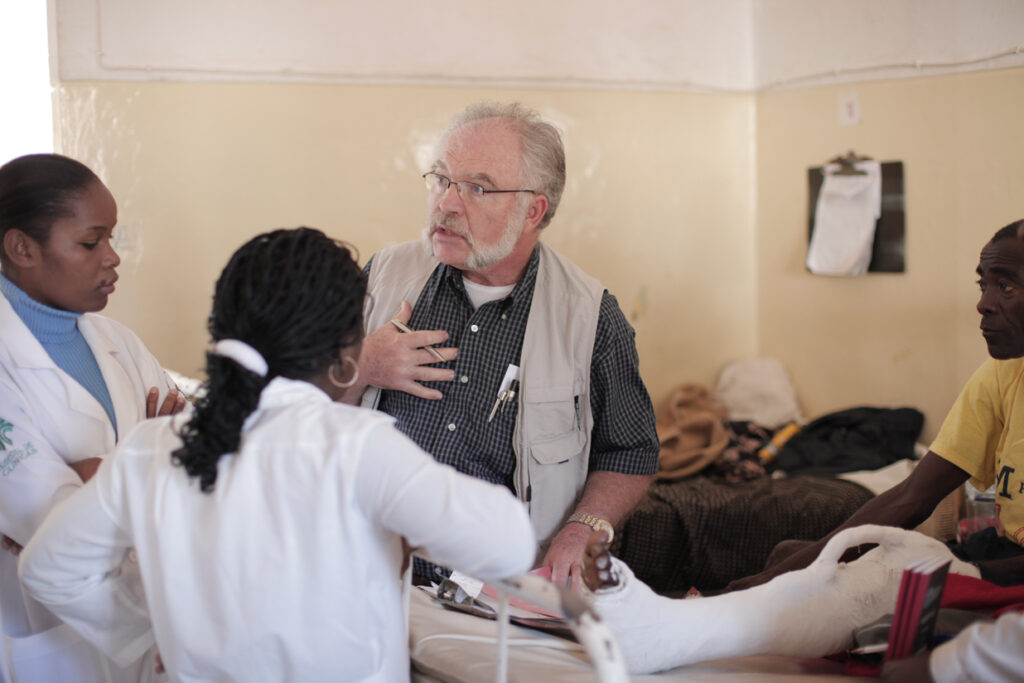
“We’ve had the privilege of working with the Mission Aviation Fellowship for the last 20 years, as they’ve come alongside us and helped us solve some of the physics problems of working in a country the size of Angola which is comparable to all of the province of Ontario and half of Manitoba in terms of physical geography, and I have patients who come from all over the country. And they needed to be brought 1000 to 2000 kilometers to our care, and to try to do it by road or by land, sometimes being a seven day trip, and when they get on a plane…they’re getting to us in two and three hours, We have incredible opportunities to serve, and it’s just wonderful to be able to share this with Canadians who might and could and should want to get behind us and care for us, care for what we’re doing,” he noted.
The last number of decades, too, Dr. Foster, reflected on meeting many different people and helping many different people throughout the decades.
“I’ve had the privilege of seeing Angolans realize that the time has come for them to step into my shoes. And for them to provide and send their young people to get training at CML [and] to get the skill sets that I was given 40 and 50 years ago here in Toronto and that they can acquire the skill sets, and they can serve in much the same way I have, and that to me has to see that evolution step, to see the recognition that the time has come for Christians in Angola to care for their neighbor and to care for their loved ones, and that they can do it, and that they can do it even better than I can, because after even all these years, my skill sets in the local language, vernacular languages, the tribal languages of some 90 different groups,” Foster noted. “I will never be able to speak like a native…so, to have an Angolan stepping into this gap and winning the confidence of their own citizens and fellow Africans has just been the greatest privilege. To be able to watch an Angolan surgeon taking my place as the director of the hospital and in the next few months we’re going to have an official ceremony to recognize that I am stepping away from the clinical directorship of the hospital and handing it to an Angolan who’s been trained to do that. In some sense, it is a symbolic step of what has taken practically two generations to make happen, and to me that would be one of the standout things I’ve witnessed.”
As well, Dr. Foster, has come from a long line of family members who’ve been missionaries and who’ve done much in Africa, and he has taken the mantle.
“It was a privilege to watch my dad [and do] rounds with him…having him teach me tricks of the trade when I first arrived years ago, and when he started to think about retiring from his day-to-day work. He would come back and fill in to allow some of my colleagues to take a one-month break, and he would come and pick my brains about what the disease patterns that he was going to see would look like. What I and what I’m watching us and having this kind of transition through the years through the generations has been a privilege that few others have had because I’ve had the privilege of watching the three generations of people around me and now, I’m watching the younger generation and the people who are sons and daughters of people that I helped to deliver 30 and 40 years ago have come work with me.”
However, along with his work in Angola, Dr. Foster has been a teacher and mentor as Clinical Associate Professor of Surgery at McMaster since the early 1990s, and has provided ethical guidance.
“One of the biggest questions I ask medical students: ‘Is why they keep chasing the almighty dollar sign?’ When will they discover that money in this world won’t bring them satisfaction, and that they need to learn that investing in people and spending time addressing their needs and listening to their hearts…will have a greater satisfaction in caring for people when we make the needs of others our focus and not simply chase the dreams of what society sells us,” he explained. “It’s turning out we’re not satisfied by things, and to discover that we will can only truly be satisfied when we serve others and have in the privilege of doing so in Christ’s name…seeing other people discover a joy that surpasses the wisdom of this world, and that’s what I tell my medical students: be very careful about choosing lifestyle and making your choices…and some of them come out and spend a month with us in Angola, and most of them have gone on to become professionals who are mobilizing doctors and working internationally as result which has been great to see.”
A person that has been on Foster’s side has been his wife, Peggy.
“After marrying her, I remember Peggy not being frightened by me telling her that I was preparing to go to Africa. We ended up going to Angola…to meet my parents because…she hadn’t met them before we got married and we spent three weeks in there and a week in South Africa,” he noted. “And then in 1975 we spent those months in Angola during their run up to Independence while Peggy was expecting our first child and she ended up getting evacuated and having to leave…ten weeks before I did…[however] we have had much joy raising our four kids [despite] the confusion around us because of war, poverty and stress of our environment…but at the same time being able to see God’s faithfulness to us and His provision of our physical needs, our food, clothes and home…I has always been reassuring that she has always felt that she could trust me and our 53 years together is a [testament] to that bond.”
While the work that he has done has been vital to the people of Angola, Dr. Foster has been recognized with multiple honours, especially with the Medal of Peace and Humanitarian Development by the President of Angola which was presented to him in 2025.
“I was rather surprised that somebody like myself from the bush of Central Angola, who was long regarded as a thorn in the side of the government, would actually be recognized…but one of the things I discovered was the President of Angola’s dad worked in a mission hospital back in the 1960s and the we had met four years ago, just after COVID….we spoke about what the future held for Angola when we can get focused on the needs of rural peoples, and those conversations have started this whole process of [implementing] training, and other things,” he reflected. “In many ways, these last 45 to 50 years, have been characterized by my work and life in Angola, serving amongst people, and being often called all sorts of names during the war years or accused of being a CIA agent for example…and yet to be given this medal was a symbol of the people recognizing that we’ve been there to make the country better. So, it was a privilege to receive that medal…and in 2010 the Canadian College of Surgeons granted me their Humanitarian of the Year award for all the things that had gone on in our earlier years as well which was an honor. But at the end of the day, one turns and points people to Jesus…asking what did he do for us? He hung on a cross for the likes of us and gave his life up for us, and so I haven’t had to do that in one sense, but the privilege of serving many people through the years.”


