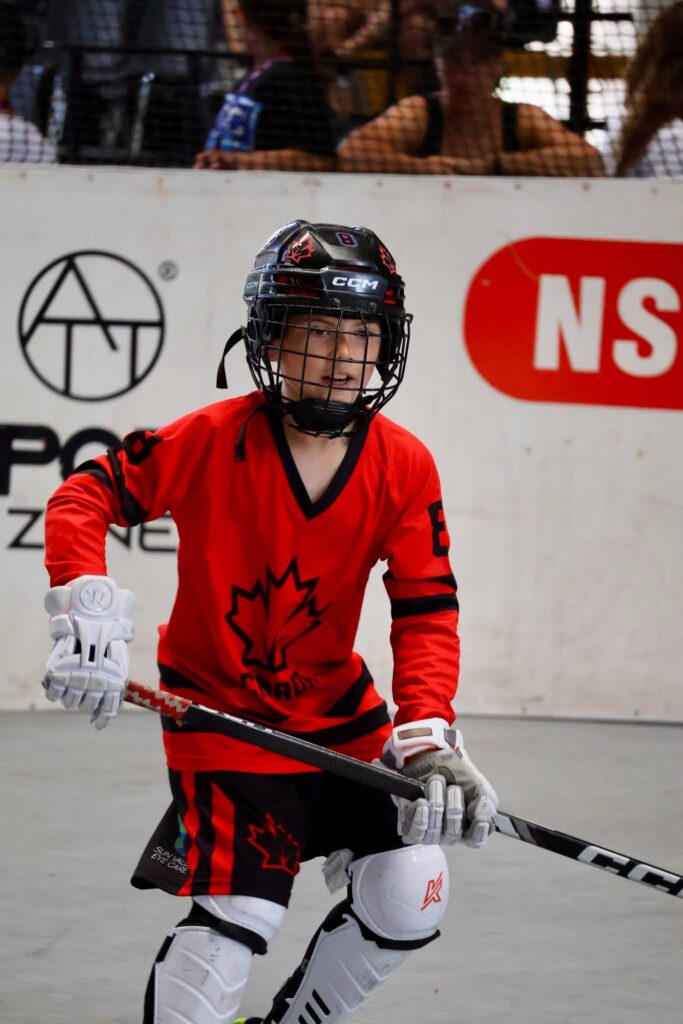
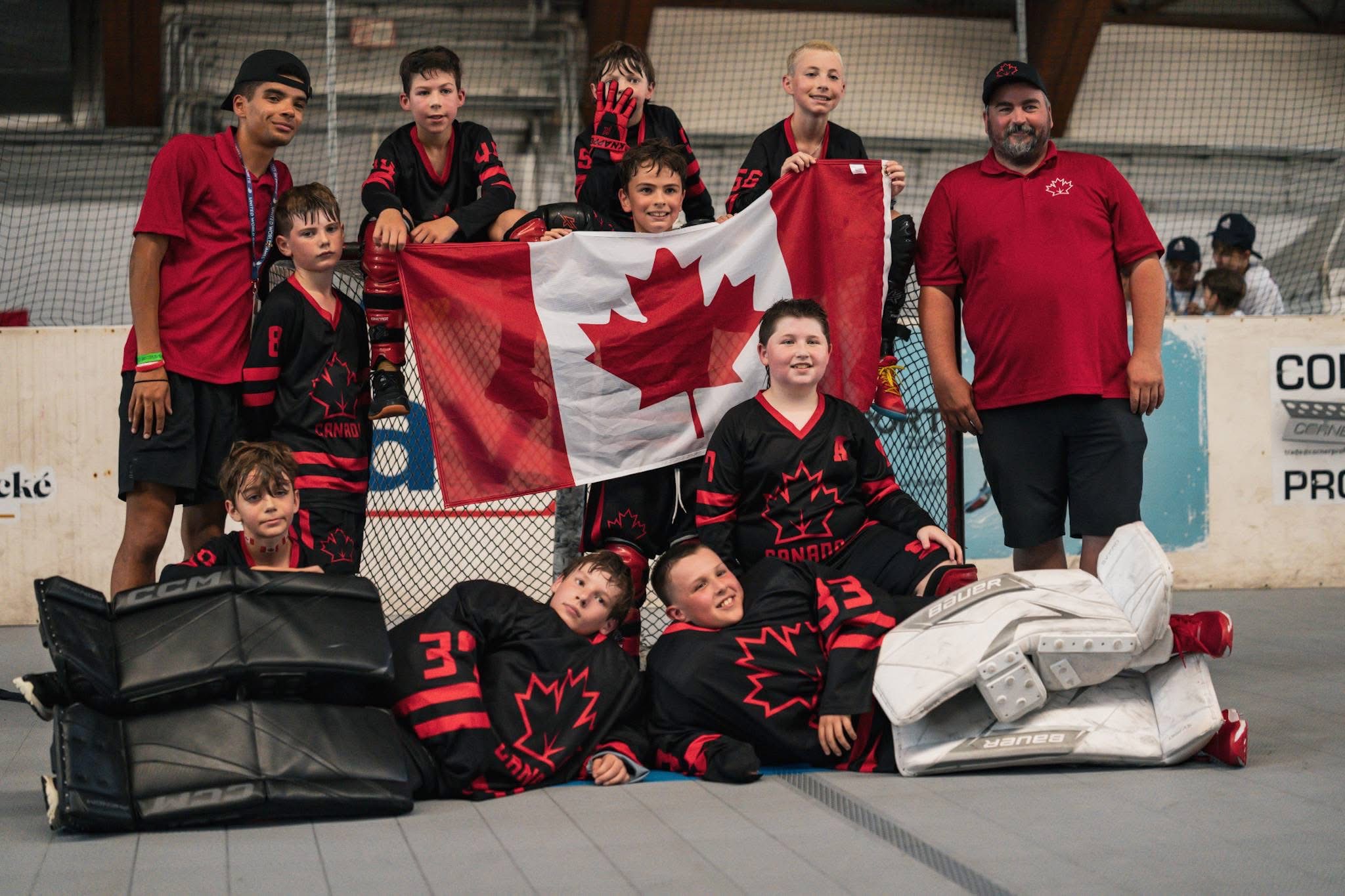
While Team Canada (U-11 boys ball hockey team) lost in the semi-finals of the United World Games in June 2026, it gave the players time to bond, compete, build memories and contribute to the growth of the sport on an international level.
Markus Mathurin, who coached the team who has his own history as a ball hockey player, discussed qualifying for the games.
“The owner of BHI had a great relationship and connection with the president of the World Ball Hockey Federation. He asked Dan [Gilbert] to take over and oversee the Team Canada program after it was let go by someone who ran it here in Ontario. Dan said yes, and ever since, he and his wife Linda have been able to create this program, which has grown tremendously over the past three years,” he said.
However, Mathurin explained how players were chosen as well as the tournament breakdown.
“In the past, we only selected players from Ontario [but] last year, we decided that since this is Team Canada…we wanted to be true to that and open the doors to hosting tryouts in Alberta and Quebec [and] did the same thing again this year….In 2025, we had around ten players from Alberta throughout the program, and around ten from Quebec, and the rest from Ontario…[and] the tryouts were set up as simple one-day, one-hour sessions. We recorded the sessions, and the coaching staff went through the video footage to evaluate. We are present at the tryouts, but the selection process goes further as we replay, discuss, and then pick the team,” he said. “As for the tournament…it was a round-robin style of play. Every division is different in terms of player ages… depending on how many teams are in each. If there are four teams, you play each team twice. They give you at least six round-robin games through Friday and Saturday. Depending on where you seed, you advance to the semifinals [and] if you win the semifinals, you go to the gold medal game. If you lose, there is a bronze medal game. You are guaranteed games on Sunday for the playoffs.”
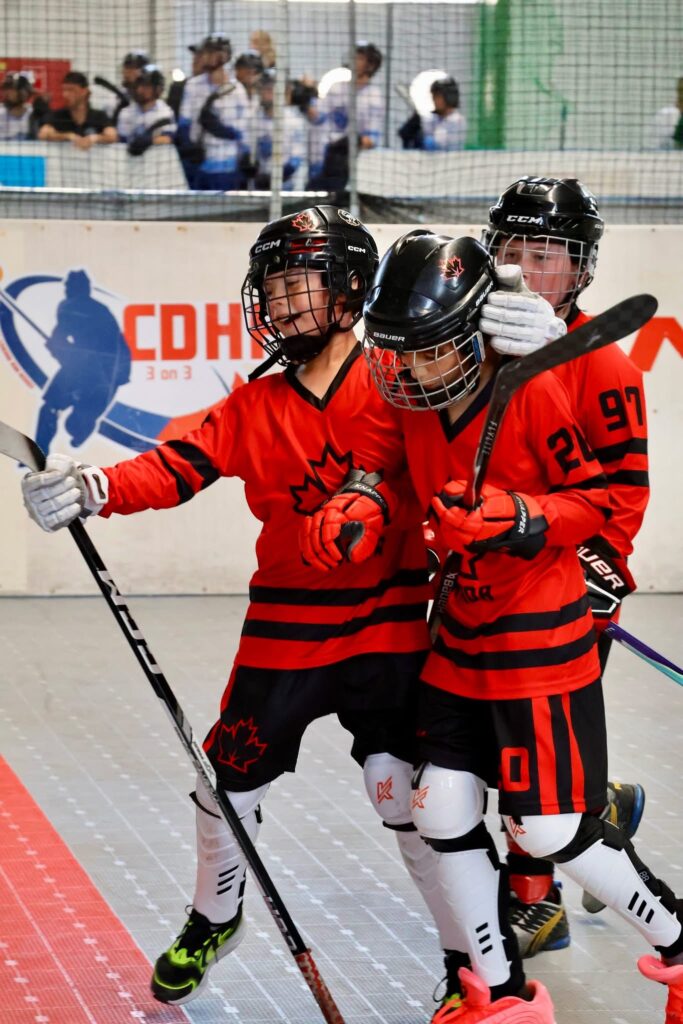
While the program went with a smaller team to the tournament, Mathurin praised the kids’ performance.
“A highlight for me during the round-robin was seeing the team come together so fast. These teams are put together without spending every day practicing prior to going. You practice once a week or once every other week, and some teams from Alberta, Ontario, and Quebec don’t even get the opportunity to practice together beforehand,” he stated. “Seeing how quickly the team comes together in a fast-paced three-on-three game is always a highlight. Winning our first game against the Czech Republic was a great confidence boost for the boys to start off strong. We lost our second game in a shootout, which was a very intense game. Coming back from a three- or four-goal deficit to tie it before losing in the shootout showed great resilience.”
Nevertheless, Team Canada ended up having four round robin games, and competing for a bronze medal which they ultimately lost.
“Our fourth round-robin game determined where we finished. We played a Quebec team that had beaten us by two goals in the round-robin. In the semifinal, we played hard against them and ended up losing in a shootout. It was an incredible game, and I don’t think the other team expected it. We lost, but we advanced to the bronze medal game…and unfortunately… lost that game four to two against the other Quebec team. It was another close game where they battled hard. We didn’t medal, but finishing fourth….with a short bench which was a big achievement. Quebec Black ended up winning the gold medal game,” he noted.
Nevertheless, the development of team Canada is rooted in Mathurin’s work as coach of the Badger’s ball hockey program in Brantford.
“In 2022, I got an opportunity with a friend to start a program for kids to travel across Ontario to compete at tournaments. We started off with one team. The first year went great; the kids loved it. We saw a lot of kids that had great potential in the sport who could compete in a competitive environment, so we decided to open it across all divisions. In 2024, the person I started it with left the program, and I took it over and have been overseeing it since then,” Mathurin explained. “We have about 70 athletes in the Brantford Badgers program, and we compete in about eight to ten tournaments…in regards to coaching internationally, I got asked to coach Team Canada for the United World Games in 2024, which was a huge honor and…a one-in-a-million chance to not only cross the border to play your favorite sport, but to also represent your country.”
However, the popularity of ball hockey has rapidly grown over the years in both North America and overseas.
“When I was younger, I thought ball hockey was just a local sport you’d play on the road or in a small house league….but it is such a huge sport. In terms of ice hockey, I don’t think it’s there yet with professional leagues, but it’s really huge in terms of people’s commitment to growing the game. The biggest part of the world for ball hockey is Quebec. Quebec has professional leagues, as well as AAA, AA, and A for kids….and right now, they are the [standard] of many of the ball programs aspire to be,” he explained. “For someone who may not know, ball hockey…it’s played in countries such as the Czech Republic, Austria, Slovakia, Germany, the United States, and Canada. Pakistan and India have also had teams in the past. It’s a sport that’s growing progressively over countries on the European side, but it is really big here in Canada. Quebec is mainly the foundation where ball hockey is respected as a high-level sport.”
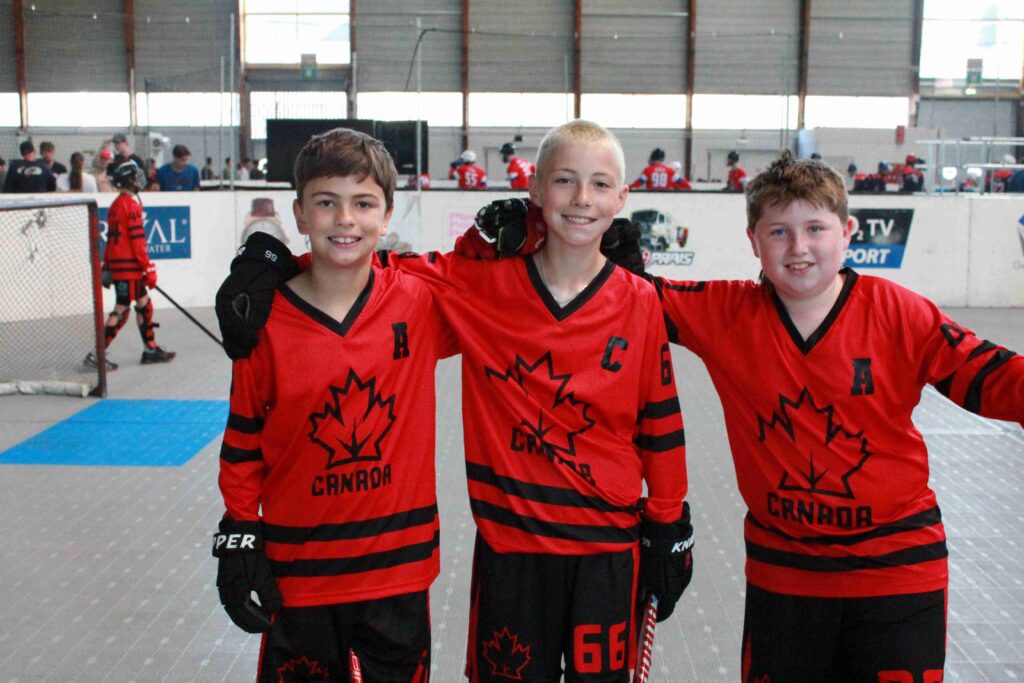
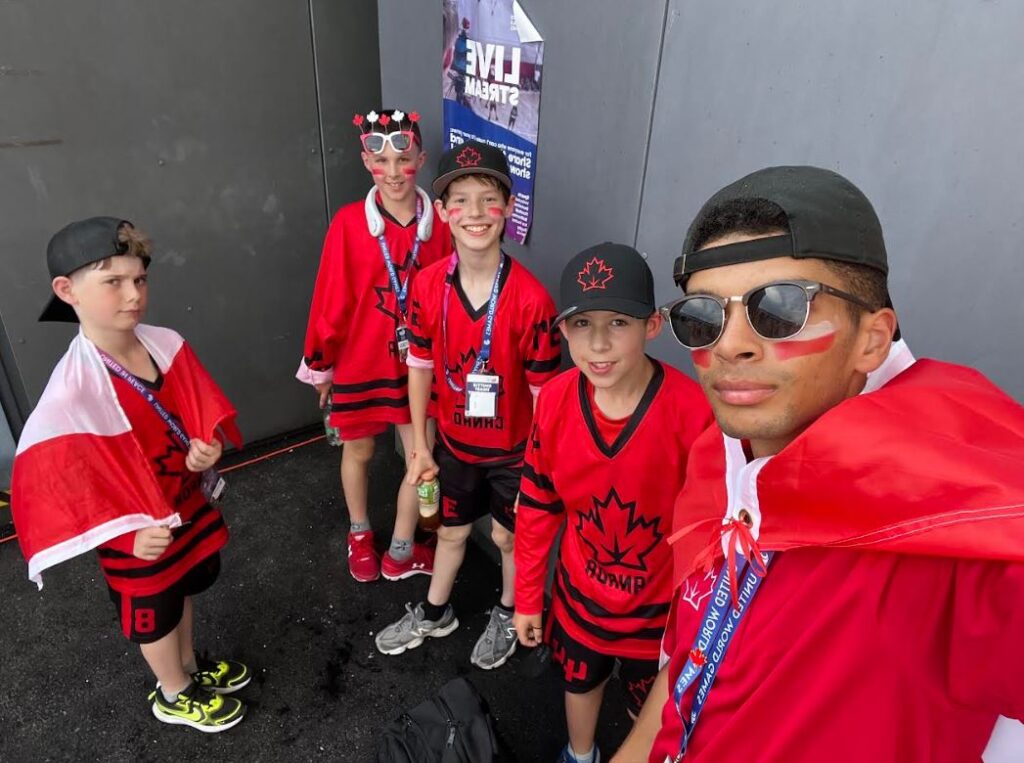
Along with playing, the kids had a chance to bond and build friendships before and during tournament play.
“The week before we played, while sightseeing in Germany, I pushed for a lot of team bonding events. That is the reason we were able to play so well, despite the kids not knowing each other beforehand. We had a kid from Quebec who spoke very little English [but] by the end of the trip, him and the English-speaking kids from Ontario were best friends. Even with the language barrier, it shows how well they bonded and how friendships were quickly made,” he noted. “And every year you take away something different from these tournaments. This year, I learned that no matter what type of players you have or where they’re from, team bonding is vital to a team’s success…[and] the kids and their parents will have those memories for the rest of their lives,” he said.
While the ball hockey program has continued to evolve at the international level, other sports are key for children’s development.
“The United World Games offers a wide variety of sports….not just ball hockey, but basketball, soccer, volleyball, and flag football…so the goal of our program is to bring as many teams as we can across other sports to represent Canada. For the past three years, we’ve only brought two to four ball hockey teams,” he stated. “We want to bring Canadian kids and teams to represent other sports and show everyone that we are invested in youth sports and development…we are currently in the process of trying to bring a volleyball team, a flag football team, and possibly lacrosse teams so we have many teams representing our country.”
However, there are some big take-aways when children participate in programs such as this one.
“The biggest takeaway is the experience. Not a lot of people get to do it, and it’s an honor and a privilege to get a chance to represent your country too. I told the kids to enjoy the experience…and I made them aware…that there would be some losses and upsets…but not everyone gets to go to Europe to play ball hockey and represent Canada…[and at the end of the day] it’s about enjoying the experience, competing and having fun,” Mathurin stated.