

For Priya Dass, PTO/founder of Brantford-based Curry Fresh Canada, the last year and a half has been both a busy period and a successful one, highlighted with an approval for a patent, earning several grants and awards as well as being featured on Dragons’ Den, a nationally televised reality show.
Dass, along with Rajan Gosain, the company’s head of manufacturing, recently had a chance to pitch their innovative product and food technology to the dragons.
“Like many entrepreneurs, we applied to Dragons’ Den to get a national audience. On Dragons’ Den, you normally get half an hour without any background…the Dragons don’t know about you, your company, or your technology, and they don’t receive any documents beforehand. In half an hour, you have to convince them about your product and service. During the episode, Arlene Dickenson mentioned that there is a similar technology from Hong Kong…which we were not aware of at the time. Later, we found out what she was talking about was ASAP (Advanced Sous-Vide Aseptic Packaging),” he explained. “On our website and social media…I posted a comparison between TAPS, which is our technology, and ASAP. TAPS is the first pressure sterilization. If you look at our U.S. patent, it mentions TAPS is the first pressure sterilization for low-acid food. ASAP (what Arlene mentioned), is basically sous-vide…a thermal technology, whereas TAPS (or HPP) is a non-thermal technology. There is a fundamental difference between the two technologies. Because she said that on the episode, every Dragon got confused and thought the technology already existed, so there was no chance we could close a deal. Regardless, people saw the episode, and we expect them to inquire about what TAPS is and how milk can get a 100-day shelf life for example. The Dragons were eating and tasting our food on set, and we were able to prove that this technology can keep refrigerated food fresh for more than 100 days. That was our purpose, and I think we accomplished what we set out to do on the show.”
However, Dass continued with some of the important takeaways from being on a show like the Dragons’ Den.
“The positives are huge because Dragons’ Den airs all over the country. Across roughly 24 episodes a year, with three or four pitches per episode, they feature about 100 entrepreneurs from across Canada….and we were the first food technology company. I have been watching Dragons’ Den and Shark Tank for a long time; actually, I made it to the third round of Shark Tank in the U.S. back in 2019, right before the fourth-round filming stage,” Dass noted. “Being on the show gives you a strong national profile and a high-visibility platform. After the show aired [on November 19th, 2026]…we are expecting a lot of visibility and inquiries, and people are already very interested in learning about this technology. When it came to the money aspect…we could have asked for $100,000 or $200,000 and gotten a deal. But. that wasn’t our purpose. Our purpose was to get a national audience, and we asked for $1.2 million, which is pretty high by Dragons’ Den standards, well above the average ask on the show.”

Nevertheless, Dass explained the reasoning behind the high funding request.
“At that point in time, we had just received our patent and were in 200 grocery stores in the United States alone. We were looking for $1.2 million…including $500,000 for inventory for those 200 stores. However, after we filmed in May 2026, we transitioned the following month to become a full technology licensing company. We stopped selling our retail product because we realized it is better to take our technology everywhere; across the U.S., Canada, and globally, “he said. “This past October, we attended a trade show in Singapore as part of a Canadian trade delegation; only six companies were selected, and we were one of them. Our goal now is to present our technology to food manufacturers and processors all over the world rather than building a retail brand or selling products directly.”
There were aspects that Dass liked about the show and also the opportunity to find mentors with business backgrounds aboard.
“I liked that the Dragons asked very pointed questions about our business. Having watched many episodes, I knew they don’t normally deal with food technology, which was a challenge for us. However, they grasped it very quickly despite Arlene’s initial counterargument. When you tell people for the first time that food can stay fresh in the fridge for a year without preservatives, they find it hard to believe, they often ask if we mean three years like canned goods, because nothing like this exists in refrigeration today. The Dragons understood the concept right away,” he noted. “What aired was only 11 minutes, but we were in the Den for close to 40 minutes. One of the Dragons, Manjit Minhas, told us that we needed business mentorship because we are inventors, not business people, and we agreed. That was one of the reasons why we went on the show….we have technology that can go all over the world, [but] we need business experts to take it forward. Similarly, Wes Hall offered mentorship through his network, which wasn’t shown in the final cut. Overall, their feedback was that we are good people with great technology, we just need business mentorship…which we completely agreed with.”
Along with being on national television, Dass discussed securing a U.S patent for their food technology, another success for the company.
“Getting the patent was a major milestone because I originally filed it in September 2016. To give you a brief background: High-Pressure Processing (HPP) has been used in food since the 1990s, when it was commercialized in Japan. In basic biology terms, HPP only kills bacteria; it cannot kill bacterial spores. That is why HPP, which is mostly used for fruit juices, salsa, or hummus, gives you 50 to 100 days of refrigerated shelf life. It is the same difference as thermal pasteurization versus thermal sterilization. Refrigerated grocery store milk is thermally pasteurized; heated to 71°C for 15 seconds, which kills only bacteria, so it goes bad in three or four weeks. On the other hand, shelf-stable UHT (Ultra-High Temperature) milk is thermally sterilized, heated to 121°C for three minutes, which kills bacterial spores as well,’ Dass explained. “Similarly, traditional HPP is essentially high-pressure pasteurization. We developed TAPS (Thermal-Assisted Pressure Sterilization; earlier called CAPS (Carrier-Assisted Pressure Sterilization), which kills both bacteria and bacterial spores. While HPP-treated food has a shelf life of 50 to 100 days, TAPS extends it to 500 days—over a year—for meals, juices, curry sauces, Asian meals, Italian meals, or any food containing moisture, since high pressure requires moisture. This solves the biggest trade-off in the food industry: eating fresh versus having a long shelf life. If you want fresh food with a 15- to 30-day shelf life, most of it gets wasted, Canada has $60 billion in food waste, the U.S. has $200 billion, and globally it is $2.6 trillion. Conversely, if you want a long shelf life through acidic, retort, or frozen foods, you compromise original taste, texture, and nutrients. TAPS is the only food production technology that allows you to eat fresh while maintaining a long shelf life. That is why getting this patent was so important, and why it took ten years and extensive lab report, along with persistent work from our patent attorney, Steve Cobb from Florida, to convince the U.S. patent examiner that this was a genuine breakthrough. Receiving this patent will completely change the trajectory of our venture.”
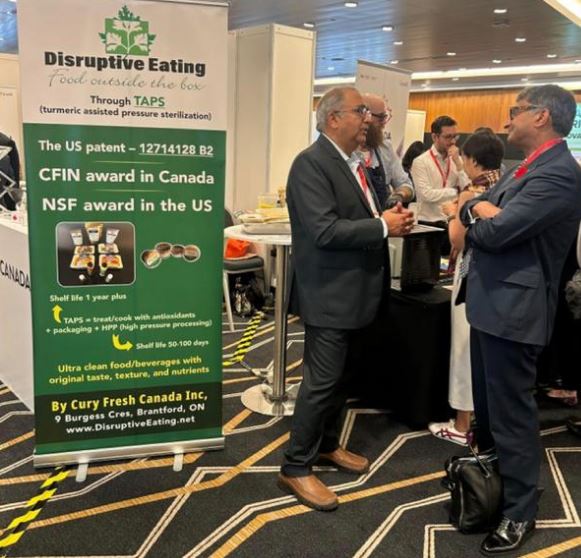
As well, the company was selected as a top 40 venture by Foodtech Frontier, which has given it recognition in the industry, along with additional grants it has earned.
“When you tell people you have a breakthrough technology, they often don’t believe you, especially because I don’t have a food science background. I am an electronics engineer, not a PhD scientist working in a university or corporate lab…we are a small business. People don’t take our claims at face value. Last April, we received a $300,000 USD National Science Foundation (NSF) award. That was our first third-party validation, as the NSF award is one of the biggest STEM awards in the U.S. However, we didn’t have our patent yet at that time,” Dass stated. “When I came to Canada, I connected with the Canadian Food Innovation Network (CFIN) and attended their 12-week cohort last year, which acts as a one-stop shop for food ventures covering business formation, operations, marketing, and fundraising. We also received a $90,000 CFIN award right after getting our patent, which served as our first third-party validation in Canada. Then came the Foodtech Frontier, where CFIN selects 40 food ventures across Canada. Being selected connects you to the entire Canadian packaged-food ecosystem. We received the award in Toronto at the BDC building on November 16th, surrounded by food industry leaders and venture capitalists. In February 2927, they will feature us at their event in Ottawa in front of 300 to 400 stakeholders from across Canada. That visibility ensures everyone in the food industry knows who we are and what our technology does.”
Accordingly, the CFIN grant will provide the brand an opportunity to grow beyond Indian cuisine.
“I started my career with an Indian restaurant and wanted to build a restaurant chain, which led me to look for a technology that could keep our curry sauces fresh for a long time. Now that we have this technology, we want to expand beyond Indian food. We used the CFIN grant to test TAPS on various foods and beverages, including salmon salad, chicken salad, baked salmon, baked chicken, Asian dishes, bread, and raw meat…so we can expand our footprint across all food categories,” he explained.
However, in October 2026, Curry Fresh Canada was one of only six companies to be selected to go to Singapore for SIAW (Singapore International Agri-Food Week) as part of the Canadian trade delegation. It was also an opportunity for the brand to showcase their patented food technology, TAPS.
“It is one of the largest trade shows in Asia, and the Canadian government supports Canadian ventures there to expand their export footprint. Once selected, they arranged everything in a high-visibility Canadian Pavilion right at the entrance, where we had our own booth alongside the other six companies. The High Commissioner of Canada in Singapore even visited our booth and took a photo with Rajan, who attended the event for us. Beyond Singapore, they connected us with Canadian Trade Commissioners in Thailand, Malaysia, Vietnam, India, and Dubai. We are now working with those trade commissioners to introduce our technology to food manufacturers and processors in those countries,” Dass said. “TAPS offers some clear advantages for them: if a company already uses HPP for a 50- to 100-day shelf life, we can extend it to one year for a clear supply-chain advantage; if they sell frozen foods, we can help them transition into the fresh sector; and if they make ultra-processed foods, which make up 50% of what Canadians eat and is a global issue, they can use our technology to move into fresh products. Licensing our technology through these international connections is arguably the biggest opportunity we have had to scale globally.”

Now that Dass has established the brand’s operational roots in Brantford, he has continued to build strong partnerships and business connections across Canada, the United States and overseas.
“We chose Brantford strategically. I came from Michigan, so I wanted to stay close to Michigan while being in Ontario, which is a hub for food ventures. In 2025…there was no HPP tolling center in Ontario, so I had to go to Montreal. Since then, the owner of Natural HPP in Montreal opened a facility in Hamilton, so Ontario companies can now produce and process their food locally without traveling to Quebec. I have also been looking for a facility where we can build an integrated kitchen with an HPP plant,” he recounted. “Interestingly, Brantford used to have a Maple Leaf factory with an HPP machine, though they eventually stopped using and selling from it. Also, because Brantford is a food hub, I envision us eventually establishing an integrated one-stop facility here where clients can bring their recipes, process them with TAPS, and take them to market. For now, Brantford is a very comfortable base…especially since CFIN’s headquarters are also located here, making it easy to meet with mentors and VCs.”
Along with building a business here, there is a special connection to the area for Dass.
“I do feel a special connection to Brantford…this being the hometown of Graham Bell and I live in West Brant just five minutes drive from Bell Homestead. I am an electronics and telecom engineer and first heard about him and the Brantford to Paris experiment almost 40 years ago at BIT Sindri [Engineering College] in India. I could never have imagined in my wildest dreams that I would live near his home one day,” he said.
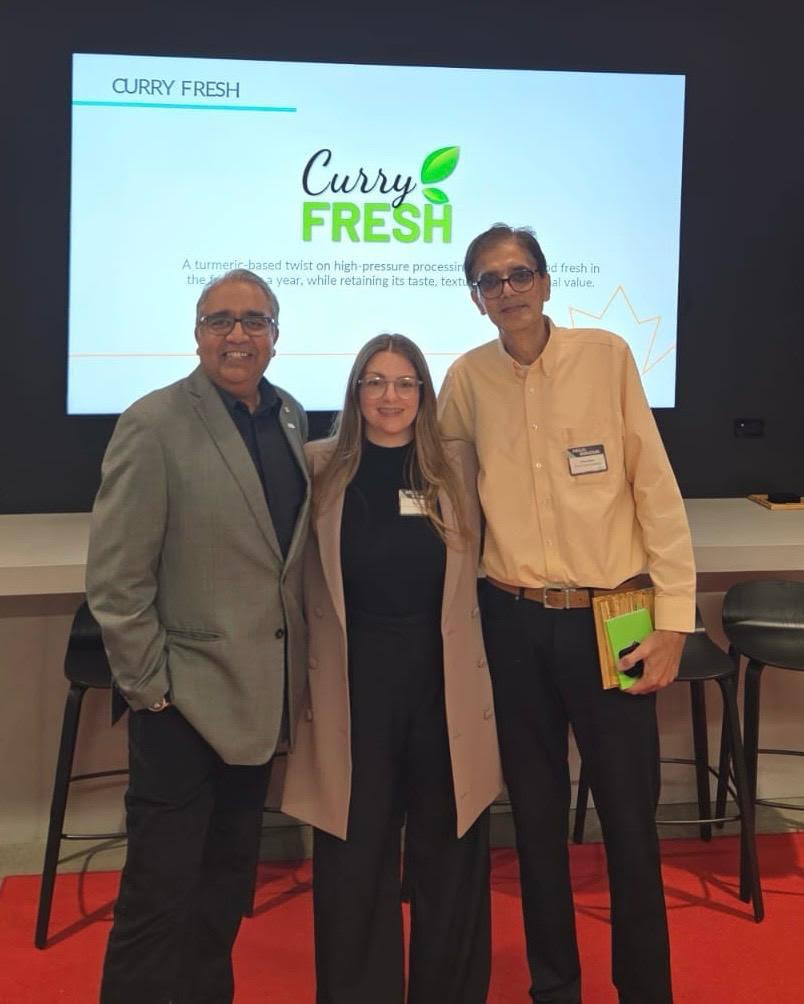
However, as this technology continues to the public as well as other companies and countries, it will enhance the way people think about food storage without sacrificing quality.
“It is very simple: everybody wants to eat home-style food. Growing up in India, I never ate packaged food because people love to cook fresh, and packaged food carries a stigma for compromising taste, texture, and nutrients. Because it isn’t possible to grow every ingredient locally year-round, people have always faced a barrier when trying to eat fresh food with a long shelf life. TAPS removes that barrier, giving people the option to eat fresh, home-style food with a long shelf life,” he stated. “TAPS is the only food preservation technique which can keep food as it is for one year plus in refrigeration….with the same taste, texture, and enhanced nutrients on account of enhanced bioavailability due to high pressure processing and antioxidants used in TAPS.”
Lastly, the brand looks to continue to build upon its successes and according to Dass, is ready to take the next major steps in the coming year and beyond.
“I feel we are finally well-positioned. Ever since I developed this technology in 2018, I was waiting for the patent, because it is very difficult to convince people you have a breakthrough when you are only ‘patent pending.’ A granted patent is the ultimate third-party validation. Looking ahead, we have filed a continuation-in-part to expand our patent, and we are filing for international protection through the PCT (Patent Cooperation Treaty) in individual countries like Singapore, Thailand, and across Europe to protect against copycats. Combined with being part of the Canadian trade delegation, and leveraging Canada’s strong, peaceful global reputation as a G7 nation…we have a major advantage entering international markets. By this time next year in 2027, I expect our technology to be in ten to 15 countries,” he said.


