
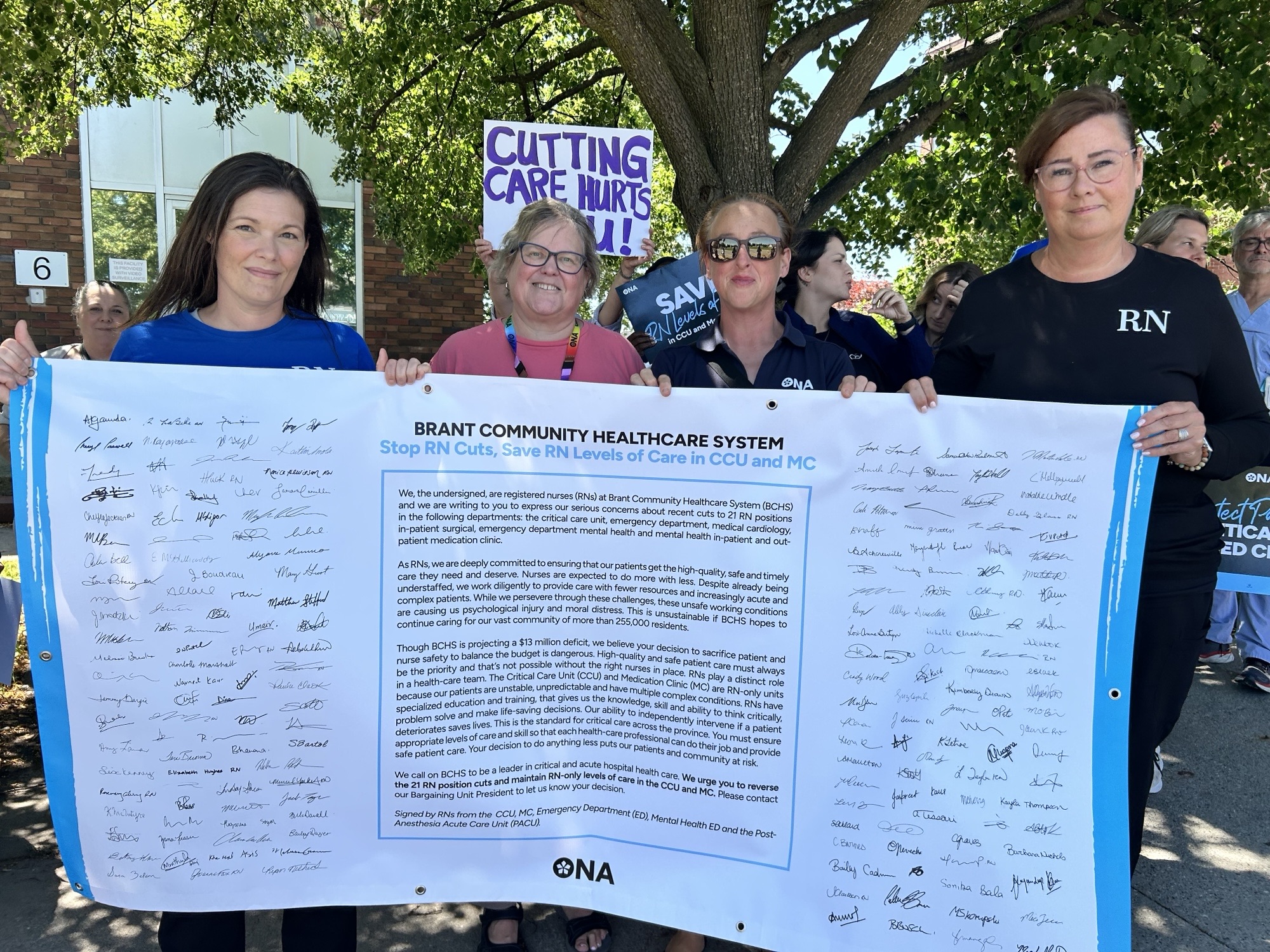
Local nurses at Brant Community Healthcare System (BCHS) opposed potential cuts during a rally on Wednesday, July 29, 2026.
Representatives delivered a banner to two of the hospital’s senior executive for Chief Executive Officer, Bonnie Camm, calling on the CEO to reverse 21 Registered Nurse (RN) position cuts and to maintain RN-only levels of care in the Critical Care Unit (CCU) and Medication Clinic (MC).
The banner, which was signed by 89 per cent of nurses in the CCU, MC, Emergency Department (ED), Mental Health ED and Post-Anesthesia Acute Care Unit (PACU), emphasizes grave concerns about patient care and unsafe working conditions.
“BCHS is trying to balance budgets by sacrificing patient and worker safety,” said Provincial President Erin Ariss, RN and Provincial President of the Ontario Nurses’ Association (ONA) . “This will cost more in the long run because the reality is, unsafe staffing conditions lead to devastating patient outcomes. Despite already being understaffed, our members are working diligently to provide care with fewer resources and increasingly acute and complex patients.”
The CCU and MC have patients that are unstable, unpredictable and who have multiple complex conditions. Registered Nurses have specialized education and training that gives them the knowledge, skill and ability to independently intervene, think critically, problem solve and make life-saving decisions. By cutting RNs and failing to maintain RN-only levels of care in these key units, patients and other health-care providers on the team will be at risk of longer wait times, delays or missed communication and care, and increased errors.
“Not only are these cuts forcing nurses to do more with less, they are putting patients and other health-care providers at risk. Every health-care professional has an important and distinct role to play on a care team. Cutting and replacing RNs to save money is a dangerous move that will cost lives. That’s not a price BCHS should be willing to pay,” added Ariss.
ONA continues to pressure the provincial government to fund hospitals adequately and to mandate safe staffing ratios. These ratios, which vary from unit to unit, ensure that there are a maximum number of patients per nurse. This is one of the best ways to ensure patients receive timely, high-quality care.
ONA is the union representing 68,000 nurses and health-care professionals, as well as 18,000 nursing student affiliates, providing care in hospitals, long-term care facilities, public health, the community, clinics and industry.


